SignalIndustrialsconstructionData story
The Boring Part
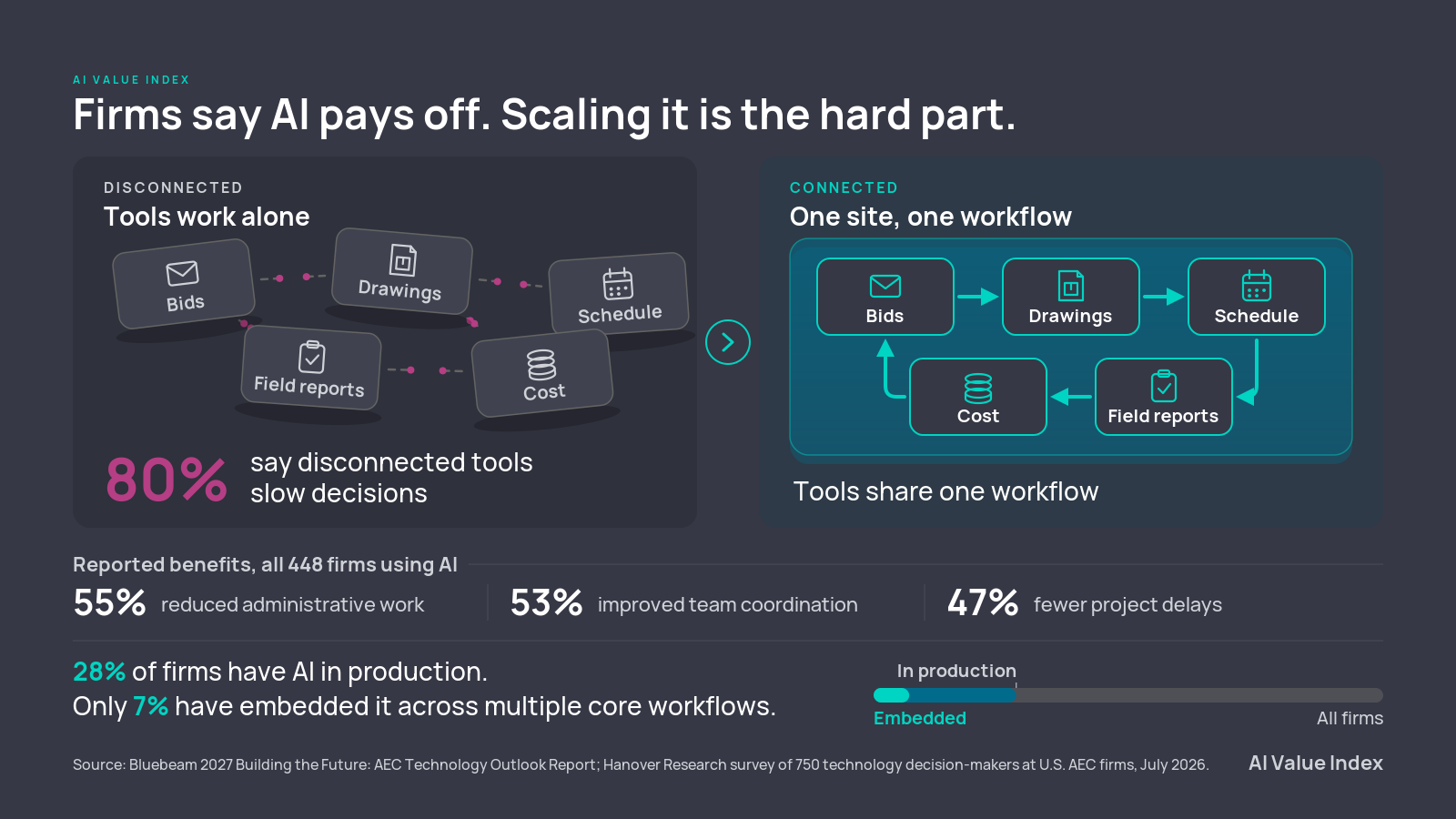
Bluebeam asked 750 tech decision-makers at firms that design and build how their affair with AI was going. Barely a quarter of their firms, 28%, had it in production. Just 7% had let it into more than one core workflow. The 28% most often credited fitting it to tools they already had. Vendor-paid.

A pilot shows a tool can work. Production means people use it on real projects, week after week. A new survey from Bluebeam says most architecture, engineering and construction firms have not made that jump.
Bluebeam, which develops solutions and services for those firms and is part of the Nemetschek Group, released its 2027 Building the Future: AEC Technology Outlook Report on Oct. 13, 2026. Hanover Research surveyed 750 technology decision-makers (manager or above) at U.S. architecture, engineering and construction firms online in July 2026. 28% of organizations have moved AI into production. Just 7% have embedded it across multiple core workflows. Another 32% are piloting.
The firms in production report returns. In Bluebeam's release, "40% of firms running AI in production report savings exceeding $500,000". The report labels that a "Self-reported estimate, base n=210." Across all 448 firms using AI, pilots included, 55% report reduced administrative burden, 53% improved coordination across teams and 47% fewer project delays.
So what got those firms past the pilot? Not money alone, by Bluebeam's count. High implementation cost was named by 50% of firms still piloting and 50% of firms that already scaled. Among firms that got AI into production, the most-cited factor was "integration with existing systems and tools (47%), ahead of cross-team collaboration (29%) and high-quality data (26%)." A clear ROI case was named by 12%. Strong leadership support, by 11%.
Jeff Sample, a senior industry development manager at Bluebeam, puts it plainly: "Nobody gets a plaque for connecting an estimating system to a document platform. That is the work, though. The firms that got AI into production did the boring part first, and the boring part is why it stuck."
Bluebeam CEO Usman Shuja frames the payoff as time for people: "The real opportunity is using AI to remove barriers, strengthen collaboration, and give the people building our world more time to focus on the work that matters most."
Earlier construction surveys on the Index found other gaps: Kahua's between adoption and value, Houzz's between hours reported and dollars modeled, BRG's between effectiveness and efficiency. Bluebeam's adds a claim about what moves a firm from pilot to production.
How to read this: it is a vendor-sponsored survey, reported by trade press (For Construction Pros, Nov. 12, 2026). The savings are self-reported. No firm is named. Bluebeam's own report says the firms that scaled are "describing their own success after the fact" and calls that "the weakest evidence in this study."
For the AI Value Index, this signal points at the plumbing, not the model. Evidence would be a named firm showing, with a stated baseline, fewer delays or less administrative time after it wired AI into the tools it already uses.
Get new AI Value Index records in your inbox.
Subscribe