4.6 min AI-assisted interpretation (American Heart Association, published Nov. 9, 2026)
8.5 min Without AI assistance (American Heart Association, published Nov. 9, 2026)
about 46% Time savings (American Heart Association, published Nov. 9, 2026)
This is a meeting abstract, not a peer-reviewed paper, and the exams were historical, not live clinic flow. Healio reported that cardiologist time also fell when the preliminary report came from a sonographer.
Kaiser Permanente Northern California cardiologists spent an average of 4.6 minutes reviewing and finalizing an AI-generated preliminary echocardiogram interpretation, compared with 8.5 minutes to generate interpretation reports without AI assistance, a time savings of about 46%. The figures come from a blinded, randomized trial of 1,200 exams previously acquired during routine care in March 2025 at 21 of the system's medical centers, presented Nov. 9, 2026, as late-breaking science at the American Heart Association's Scientific Sessions in Chicago.
Researchers say this is the first randomized trial testing an AI tool to craft a full echocardiogram report including interpretations and measurements. Cardiologists made substantial changes to 50.6% of the AI-generated preliminary interpretations, compared with 49.7% of those prepared by sonographers and cardiologists. The results met the study's criteria for the AI-assisted approach to be considered non-inferior, or comparable in accuracy, to the human-assisted approaches. The AI-assisted reports were more consistent with historical reports in the medical record than reports in the comparison group. The American Heart Association release does not name the AI vendor or model.
"Because of the large number of echocardiograms cardiologists read, even a few minutes saved per interpretation can add up to a significant amount of time over the course of a day," said co-senior author Keane K. Lee, M.D., M.S., a cardiologist at Kaiser Permanente Santa Clara Homestead Medical Center. "For patients, this could potentially mean faster turnaround of results and more access to care, and for cardiologists, more time to spend with patients." He added, "AI cannot, however, replace the human team."
What the Index says: this is a meeting abstract, not a peer-reviewed paper, and the exams were historical, not live clinic flow. The 4.6 versus 8.5 minute comparison is against interpretation without AI assistance. Healio reported that cardiologist time also fell when the preliminary report came from a sonographer, so this should not be read as AI uniquely beating a human prelim on speed. The study did not test whether AI help improves patients' long-term health, and the cardiologists knew they were in a study, so they may have changed their usual work patterns.
A Kaiser Permanente Northern California trial presented at the American Heart Association found cardiologists finished AI-assisted echo interpretations in 4.6 minutes, versus 8.5 minutes without AI, a time savings of about 46%. Comparable accuracy; a meeting abstract, not a published paper.
Healthcare – Providers
Key figures
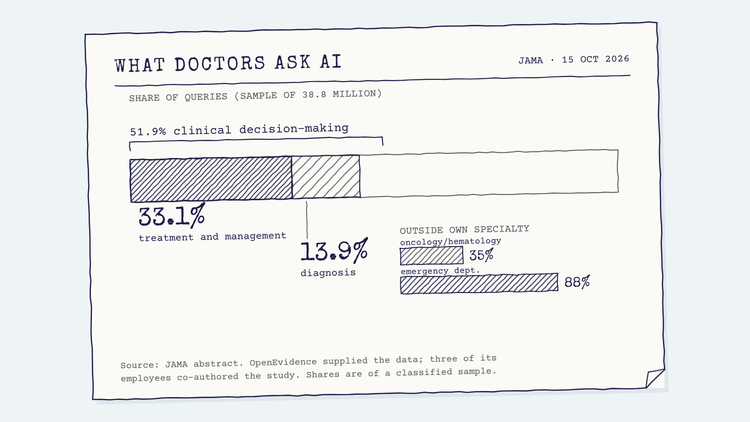
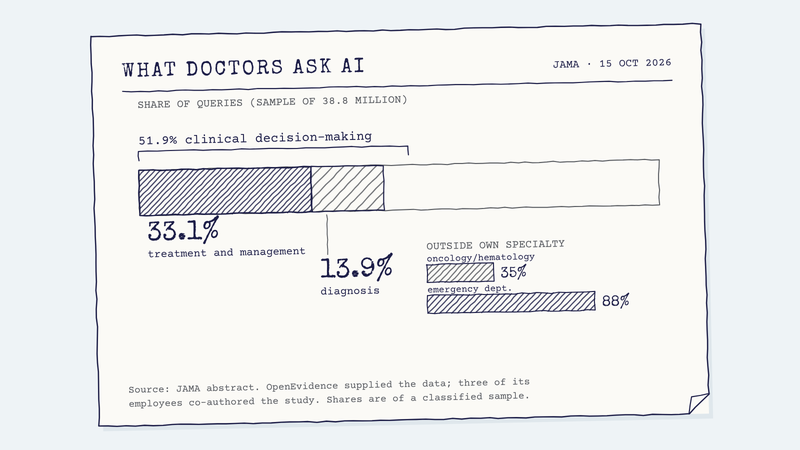
33.1% Of physician queries were about treatment and management. Diagnosis: 13.9% · clinical decision-making overall: 51.9%. (JAMA, published online 15 Oct 2026)
88% Of emergency physicians' queries were outside their own specialty. Lowest: oncologists and hematologists, 35%. (JAMA, published online 15 Oct 2026)
OpenEvidence supplied the data, and three of its employees co-authored the study. A language model classified a sample of 38.8 million queries.
The diagnosis is the scene everyone remembers. Then the patient asks what happens now, and the harder part begins: which treatment, and whether it clashes with the pills already in the bag.
That second question is the one clinicians bring to AI more often. A JAMA study published online October 15, 2026 looked at OpenEvidence, an AI clinical information platform, where "952 008 clinicians (58.5% female), including 556 200 physicians, submitted 271 million queries during the 2.5-year study period." OpenEvidence supplied the data, and three of its employees co-authored the study, IBM reports. A language model sorted a sample of 38.8 million queries by purpose.
In the abstract's words: "Most queries addressed clinical decision-making (51.9%), particularly treatment and management (33.1%), whereas diagnosis accounted for 13.9% of queries." The Key Points give those two as shares "of physician queries." Treatment outnumbers diagnosis. Neither is a majority.
Chart drawn from figures in the JAMA abstract, published online 15 Oct 2026. OpenEvidence supplied the data, and three of its employees co-authored the study.
Doctors also ask outside their own field. "Queries addressing topics outside physicians' own specialties ranged from 35% among oncologists and hematologists to 88% among emergency department physicians." For an emergency physician, outside the specialty is more or less the job description.
The question doctors bring to the machine is less often what is this and more often what now. Whether the machine's answers were any good is a different study, and this is not that study.
In a JAMA study of one AI clinical platform, treatment and management made up 33.1% of physician queries and diagnosis 13.9%. OpenEvidence, the platform, supplied the data, and three of its employees co-authored the study.
Healthcare – Providers
Key figures
83.2% MAI-DxO accuracy, hard NEJM cases. No test budget limit · text-only simulation · may not be the doctors' 56 cases. (Microsoft study in Science, abstract)
36.1% Generalist doctors, with references. Search and reference tools, 56 held-out cases · 22.3% without. (Microsoft study in Science, Results)
$2,241 Avg diagnostic cost per case at 80.9% accuracy. Budget-capped MAI-DxO · modeled test and visit prices, not billed. (Microsoft study in Science, Results)
All three figures are from Microsoft's own peer-reviewed study in Science (22 Oct 2026), measured in a controlled, text-only simulation, not in clinical practice. Costs are modeled from a hospital price list.
Microsoft's AI diagnostic system, MAI-DxO, got the right diagnosis on 83.2% of hard New England Journal of Medicine cases. Generalist doctors with search and reference tools got 36.1% on 56 of those cases, which had been held back from development. The paper doesn't say whether the 83.2% came from those same 56 cases or from all 304. The figures come from a peer-reviewed paper in Science, "Sequential diagnosis with language models," published in print on 22 October 2026. It was a simulation on written case records, not live patients, and the paper says so: "These comparisons do not establish superiority over specialists, multidisciplinary teams, or real-world clinical practice." All 15 authors work for Microsoft and hold equity in it. Microsoft paid for the study, and eight of the authors are named inventors on a Microsoft patent application for the evaluation method.
What was measured: the paper's benchmark, SDBench (Sequential Diagnosis Benchmark), turns 304 hard teaching cases published by NEJM, known as clinicopathological conference cases, into step-by-step encounters. A doctor or the AI starts from a short case summary and has to ask for history, examination findings and tests. A separate AI "gatekeeper" answers from the case record. An AI "judge" scores the final diagnosis against the published one, using a rubric written by physicians. A diagnosis counts as correct if management would be unchanged. Every test ordered adds an estimated cost, priced from the Kaiser Permanente Washington hospital chargemaster (its master price list), and questions to the patient count as a fixed doctor-visit fee. So the benchmark scores how you got to the answer, not just the answer. A second set adds 325 emergency department admissions from the MIMIC-IV-ED research database.
MAI-DxO isn't a new model. It's a software layer that directs an existing commercial language model, GPT-5 for the headline figures. Microsoft describes it as operating "like a panel of virtual physicians: each proposing diagnoses, selecting useful questions or tests, and challenging the emerging view." Averaged across the models tested, the paper says, that layer added 7.9 percentage points of accuracy on the NEJM cases and 4.4 on the emergency cases. TechCrunch reports GPT-5 alone scored 78.9% on the NEJM cases, so for GPT-5 the panel added about four points.
Diagnostic accuracy on hard NEJM cases
Diagnostic accuracy on hard NEJM cases. Share of cases diagnosed correctly in the text-only SDBench simulation, 0 to 100%. Blue: MAI-DxO. Teal: generalist doctors. Doctors were scored individually on 56 held-out cases. The paper doesn't say whether MAI-DxO's bars cover the same 56. Costs are modeled, not billed. Not a clinical result.
System or group (avg diagnostic cost)
Accuracy
MAI-DxO, no budget limit (avg diagnostic cost $5,431 a case)
83.2%
MAI-DxO, budget-capped (avg diagnostic cost $2,241 a case)
80.9%
Generalist doctors, with references (avg diagnostic cost $4,725 a case)
36.1%
Generalist doctors, no references (avg diagnostic cost $3,049 a case)
22.3%
Doctors were scored individually on 56 held-out cases. The paper doesn't say whether MAI-DxO's bars cover the same 56. Costs are modeled, not billed. Not a clinical result. Source: Science, 'Sequential diagnosis with language models' (22 Oct 2026).
The doctors were practicing generalists, in primary care and hospitals, each scored individually on part of the 56 held-back cases (an average of 36.4 cases each closed book and 34.8 open book). With no outside help, the "closed book" round, they got 22.3% right. With search and reference tools, the "open book" round, they got 36.1%. Looking things up helped but cost them: average time per case rose from 11.9 to 18.1 minutes, and diagnostic spend from $3,049 to $4,725 a case. The best single doctor reached 51.8% and was still beaten on both accuracy and cost. The comparison didn't include specialists matched to each case, or doctors working as a team.
A 2025 preprint of the same work, run on OpenAI's o3, reported 80% against 20% for physicians who were told not to use search engines or language models. The peer-reviewed figures replace those.
For AIVI the value here is accuracy and cost per case, not fewer doctors. Without a budget cap, MAI-DxO averaged $5,431 in diagnostic costs per NEJM case for its 83.2%, more than the $4,725 the doctors with references spent. With a budget cap it got 80.9% right at an average $2,241 a case, under half the doctors' figure, and 79.6% at $1,303. The doctors' costs come from the 56 held-out cases. As with accuracy, the paper doesn't say which cases the AI's costs cover, so both comparisons may be across different sets of cases. On the emergency cases it reached 80.3% at a mean $4,979 a case, against 46.8% at $3,400 for physicians with reference tools, and 73.2% at $2,634 with a budget cap. The authors frame the system as support, saying its structured reasoning "could augment human clinical judgment." The study didn't test doctors working with the AI.
The paper lists its own limits: NEJM cases "may overrepresent diagnostically challenging presentations," and neither data set includes healthy or benign visits. Doctors and AI alike worked through a text-based "oracle" rather than electronic health records or real patients, with no imaging, waveforms or pathology slides. The judge scores the diagnosis, not "therapeutic appropriateness, safety, or longitudinal management quality." The authors expect "the performance gap to narrow when comparing DxO with expert specialists or multidisciplinary specialist teams." Their summary: SDBench "measures diagnostic reasoning under idealized information conditions rather than bedside performance or patient outcomes."
TechCrunch reported the study on 22 October 2026 and noted that "Cases this complex are usually handled by specialists or physician teams, who weren't part of the comparison." TechCrunch doesn't test the figures. Microsoft's own post rounds them to 83%, 36% and 22% and calls MAI-DxO "about 3.7 and 2.3 times more accurate" than the doctors without and with references. The paper itself doesn't give those ratios, and they set the AI's score against the doctors' without saying the two cover the same cases. Microsoft also frames the work as a step toward what it calls medical superintelligence. That's Microsoft's goal, not a finding of the paper.
What would make this a graded case study: results from clinical use. Microsoft says it will run a prospective study with Beth Israel Deaconess Medical Center in Boston, where "patients will interact with the system directly, with performance measured against physicians' independent assessments." It gives no start date. A graded case would need accuracy, time or cost per case measured with clinicians using the system, against a stated baseline. Until then, no graded Index case backs this pattern.
In a peer-reviewed Science study run by Microsoft, its MAI-DxO system diagnosed 83.2% of hard NEJM cases correctly. Generalist doctors with reference tools got 36.1% on a 56-case subset; the paper doesn't say if the AI was scored on the same cases. A text-only simulation, not clinical practice.
Healthcare – Providers
What the Index says: grade 3 / 5. Headline figures are from Microsoft's customer story. Becker's Hospital Review covers the same rollout as trade press, not an independent measurement of the outcomes. That is enough to grade the deployment, but it caps at 3.
Key figures
−11.7% documentation latency, First 12 weeks · Fort Smith, AR
−29–56% incremental nurse overtime, Springfield, MO
−65% reported cognitive load, Mercy St. Louis nurses, self-reported
+20% nurse communication scores, Year over year · Fort Smith & Springfield
Figures as reported in the AIVI record, whose sources are Microsoft's customer story and Becker's Hospital Review.
A little closer to home, Mercy health system (based in Chesterfield, MO) is using Microsoft Dragon Copilot to help its nurses improve clinical workflow.
Becker's reported the first 12 weeks at Mercy's Fort Smith, Ark., location: documentation latency dropped 11.7%. Incremental nurse overtime fell 29% to 56% at Springfield.
Reported change by measure
Reported change by measure. Different measures at different sites; not additive.
Measure (place)
Reported change
Documentation latency (Fort Smith, first 12 weeks)
−11.7%
Incremental nurse overtime (Springfield)
−29 to −56%
Cognitive load (St. Louis, self-reported)
−65%
Nurse communication score (Fort Smith & Springfield, YoY)
+20%
Different measures at different sites; not additive. Source: AIVI record.
Nursing workflows can be cognitively demanding, with attention split between patients, meds, alarms and orders. Nurses at Mercy St. Louis reported a 65% reduction in cognitive load. And this seems to have translated into improved patient experience, as scores for nurse communication rose 20% year over year at the Fort Smith, AR and Springfield, MO locations.
~1/3 providers with ambient ai access, “Around a third”, per health tech experts cited by advisory.com
−15% time composing notes, Ambient-scribe users vs. look-alike non-users · UChicago Medicine
1 linked graded case, Mercy · Dragon Copilot for nurses
Figures as reported in the AIVI record. The 15% is from the JAMA Network Open study the record links; the access estimate is a claim quoted by advisory.com.
We've all been to the doctor but how many of us understand the clinical workflows our healthcare providers perform? Like a lot of professionals, they take notes. AI has proven to be excellent and improving note taking. Sounds like a perfect match. But how's it working out?
A Daily Briefing on advisor.com that was published earlier in the year cites a claim by health tech experts, that "around a third of providers currently have access to ambient AI technology, and adoption will likely grow rapidly over the next few years, especially as providers increasingly prioritize work-life balance."
The part that holds up is time. As in clinicians using an ambient-scribe tool spending about 15% less time composing notes. That's what researchers at UChicago Medicine found in a 2025 study in JAMA Network Open. The effort compared AI enabled clinicians to look-alike non-users, reading an EHR clock. 15% is a solid result, particularly when you think about the long-term impact of saving nearly 3 mins of time writing notes on every patient, every week, for months and years. Plus, adoption will likely improve utilization, with users getting better at how they use the tool as they use it regularly over time.
Still, as I noted in a previous article, the use case draws attention to the critical role of the clinician and the nuances of clinical workflows. Ambient note taking is no substitute for reviewing the takeaways and figuring out what to do next. I expect we will see more friction develop when workflows attempt to integrate AI tools, especially in healthcare.