4.6 min AI-assisted interpretation (American Heart Association, published Nov. 9, 2026)
8.5 min Without AI assistance (American Heart Association, published Nov. 9, 2026)
about 46% Time savings (American Heart Association, published Nov. 9, 2026)
This is a meeting abstract, not a peer-reviewed paper, and the exams were historical, not live clinic flow. Healio reported that cardiologist time also fell when the preliminary report came from a sonographer.
Kaiser Permanente Northern California cardiologists spent an average of 4.6 minutes reviewing and finalizing an AI-generated preliminary echocardiogram interpretation, compared with 8.5 minutes to generate interpretation reports without AI assistance, a time savings of about 46%. The figures come from a blinded, randomized trial of 1,200 exams previously acquired during routine care in March 2025 at 21 of the system's medical centers, presented Nov. 9, 2026, as late-breaking science at the American Heart Association's Scientific Sessions in Chicago.
Researchers say this is the first randomized trial testing an AI tool to craft a full echocardiogram report including interpretations and measurements. Cardiologists made substantial changes to 50.6% of the AI-generated preliminary interpretations, compared with 49.7% of those prepared by sonographers and cardiologists. The results met the study's criteria for the AI-assisted approach to be considered non-inferior, or comparable in accuracy, to the human-assisted approaches. The AI-assisted reports were more consistent with historical reports in the medical record than reports in the comparison group. The American Heart Association release does not name the AI vendor or model.
"Because of the large number of echocardiograms cardiologists read, even a few minutes saved per interpretation can add up to a significant amount of time over the course of a day," said co-senior author Keane K. Lee, M.D., M.S., a cardiologist at Kaiser Permanente Santa Clara Homestead Medical Center. "For patients, this could potentially mean faster turnaround of results and more access to care, and for cardiologists, more time to spend with patients." He added, "AI cannot, however, replace the human team."
What the Index says: this is a meeting abstract, not a peer-reviewed paper, and the exams were historical, not live clinic flow. The 4.6 versus 8.5 minute comparison is against interpretation without AI assistance. Healio reported that cardiologist time also fell when the preliminary report came from a sonographer, so this should not be read as AI uniquely beating a human prelim on speed. The study did not test whether AI help improves patients' long-term health, and the cardiologists knew they were in a study, so they may have changed their usual work patterns.
A Kaiser Permanente Northern California trial presented at the American Heart Association found cardiologists finished AI-assisted echo interpretations in 4.6 minutes, versus 8.5 minutes without AI, a time savings of about 46%. Comparable accuracy; a meeting abstract, not a published paper.
Utilities
At American Electric Power, a small team builds the plan for where the power will come from. The work lives in a planning workbook, and each AEP operating company has its own regulators and deadlines.
The team used an AI tool from Energy Exemplar, the company that makes its planning software, to fill in the workbook inputs. Mohamed Abukaram, AEP's director of resource planning and operational analysis, said the tool, PLEXOS Intelligence, "did 70 to 80 percent of the work, and we got a successful model run based on those inputs."
Energy Exemplar says the analysts stayed in control.
The time savings are the vendor's to claim, and it claims two. Its page says updates went "from three weeks to three days." Further down, the same page says the team cut "a three-week data update into a day."
One AEP analyst, Papa Yaw Owusu-Obeng, made a guess: "Working on a resource screening workbook can take maybe two weeks. My guess is now it will take a day." He said guess. We keep the word.
This is the kind of slow, careful work AEP is now pointing at AI.
What the Index says: AEP says the tool did most of the input work. Nobody at AEP has said how much time it saved. No measured outcome yet.
The vendor says three days, and also one. The analyst guesses one. The index will wait for AEP to count.
At American Electric Power, a small team builds the plan for where the power will come from. The work lives in a planning workbook, and each AEP operating company has its own regulators and deadlines.
Financial Services
Key figures
95% Cut in loan underwriting cycle time. Sidhu, CEO; no baseline given. (Q3 2026 earnings call, Oct 23)
76K Estimated hours saved, cumulative. Employee self-reported survey, not validated. (Sidhu on the Q3 call; bank footnote in investor deck)
>90% Cut in account opening time vs other banks. Sidhu: complex commercial accounts in minutes, not days. (Q3 2026 earnings call, Oct 23)
A loan is paperwork before it's money. At Customers Bancorp, the paperwork moves faster now.
On the bank's Q3 earnings call on October 23, CEO Samvir Sidhu said AI-powered loan underwriting changed the work. "The cycle time for this process is down 95%," he said. "This will allow the same team to handle significantly more loan throughput." He gave no baseline.
He gave a running total too. "Cumulative estimated hours saved have now grown to 76 thousand," Sidhu said.
Every banker knows the feeling. The deal is ready and the paperwork isn't. Those waiting hours go somewhere else now.
Look at the word "estimated." The bank's own footnote says where it comes from: employees surveyed on their own time saved, not validated. That's honest of them, and it's the reason the index can't do more than report it.
The bank also rebuilt how it opens commercial deposit accounts and piloted it in 10 weeks. On the call, Sidhu said the new process opens complex commercial accounts in minutes, compared with days at other institutions. "That represents an >90% reduction in cycle time." The comparison is with other banks, not its own old process.
What the Index says: an on-record claim from the top of the bank, with no baseline, and hours counted by the people who saved them. Worth reporting. Worth checking.
Same team, more loans. That's the claim. The index will believe it when the throughput shows up.
A loan is paperwork before it's money. At Customers Bancorp, the paperwork moves faster now.
Public Sector
Key figures
56% Cut in dispatchers' call load in the past 30 days, as KAIT reports. No method or baseline published. (KAIT, 29 Oct 2026)
Nearly 5,000 Calls Lezle answered from Sept. 29 to Oct. 28. Dispatchers say it resolves more than half of them itself. (KAIT, 29 Oct 2026)
Figures from KAIT and dispatchers, not a city or county document. Non-emergency lines only; Lezle never answers 911.
At a 911 center, a call about a records request and a call about a fire can ring at the same time, and on some shifts there are only three people to answer them. Jonesboro, Ark., has put a machine on the first kind of call so its dispatchers can take the second.
The machine is an AI call taker the center named Lezle. Local station KAIT reported on Oct. 29 that Lezle, "the system answering non-emergency calls in Craighead County for nearly two months, has cut dispatchers' call load by 56% in the past 30 days." KAIT adds: "From Sept. 29 to Oct. 28, Lezle answered nearly 5,000 calls. Dispatchers say it resolves more than half of them itself, especially when people need help with clerical matters, such as records or warrants, then transfers callers to the correct person."
The center is run by the City of Jonesboro. According to the city, Jonesboro E911 dispatches for the Craighead County Sheriff's Department and police and fire departments across the county, "providing non-emergency and emergency 9-1-1 services to the citizens of Craighead County." When Lezle started in September, KAIT reported that "staffing limitations mean that some shifts run with as few as three dispatchers on duty" and that the center employs 22 full-time dispatchers working 12-hour shifts.
Lezle does not answer 911. "She's never going to answer a 911 call," training coordinator Cristy Hundley told KAIT in September. "And if she determines that a non-emergency call is actually an emergency, she's going to send it straight to a dispatcher right then." Dispatcher Terra Summers told KAIT in October that trigger words such as "emergency," "breathing" or "fire" immediately transfer a caller to a live dispatcher. On the non-emergency lines, KATV reported that Lezle can "text callers information and direct them to a website or online form," or enter a non-emergent call "into the system for an officer to be dispatched," and that "Live dispatchers will be monitoring the system at all times."
For the people on the floor, the point is time. "We're trying to run a radio while also answering the 911s, while also answering the non-emergencies," dispatcher Savannah Tinsley said in September. "It relieves a lot of stress and extra workload." In October, Summers put it this way: "70 hours might not sound like a lot, but when you think about the majority of calls taking five minutes or less, that's a lot of calls, so she's definitely made a positive impact." KAIT does not say what period the 70 hours covers.
It has made mistakes. Early on, Summers said, Lezle told a caller reporting an accident, "Please go online to file this accident report." "Well, with any car accident, we're going to send an officer," she said. Dispatchers report errors to upper administration, which fixes them or sends them to the programmer.
The software comes from Prepared by AXON. When the city council approved it in January, KAIT reported that "The software carries a price tag of around $200,000 per year," and that E-911 Director Ronnie Sturch said savings from dropping other services, including a call tree and a translation service, would offset it. Deputy director Mellenee Bennett told KAIT that "The AI program is not designed to replace any dispatcher."
Jonesboro resident Nicholas Sides, who has not called Lezle, told KAIT he is wary of AI but watching. "I just think that we need to use it in the right ways," he said. A published count from the city, with its method, is what would show whether the 56% holds.
Lezle, an AI system on the non-emergency lines at Jonesboro's E-911 center in Craighead County, Ark., "has cut dispatchers' call load by 56% in the past 30 days," KAIT reports. The figures come from the station and dispatchers, not a published city count.
Industrials
Key figures
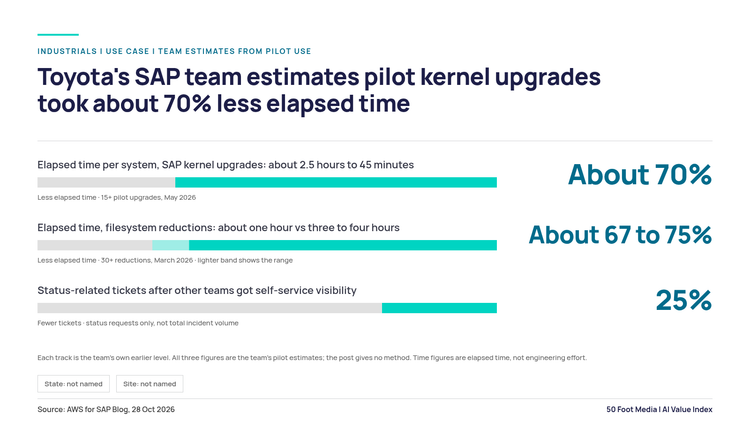
About 2.5 hours to 45 minutes Estimated elapsed completion time per system for SAP kernel upgrades, about 70% less. 15+ pilot upgrades, May 2026. (AWS for SAP Blog, 28 Oct 2026)
About one hour Estimated elapsed time for filesystem reductions, compared with three to four hours previously, about 67 to 75% less. 30+ reductions, March 2026. (AWS for SAP Blog, 28 Oct 2026)
25% Estimated reduction in status-related tickets after other teams got self-service visibility. Status requests only. (AWS for SAP Blog, 28 Oct 2026)
Published on AWS's blog by two AWS staff, co-authored with Toyota Motor North America's SAP team, and built on the AWS services it describes. Every figure is the team's own estimate from pilot use and has not been independently verified.
SAP maintenance leaves no room for improvising. Application servers drain before central services stop, shared databases must not be stopped while the applications that depend on them are still running, and everything comes back up in a set order. Engineers on Toyota Motor North America's SAP team used to work through that runbook while moving between terminals, SAP GUIs, spreadsheets and AWS consoles.
During the pilot, that job changed. In an AWS blog post published October 28, 2026 and co-authored with the team, Toyota describes BasisPilot, an in-house operations platform with an AI assistant built in. It covers "20 SAP systems on 60+ Amazon EC2 hosts across development, test, stage, and production environments." The key line: "During pilot use, the engineer's role shifted from executing a manual runbook to supervising an approved workflow."
The risk with automation is rarely that the tool is too weak. It is switching it on before anyone has built a way to stop it. Toyota's team built the stop first. Viewer roles stay read-only. "Production actions, multi-tenant database hosts, and destructive operations always create a pending approval instead of executing." Before a kernel upgrade, the assistant shows a pre-check with Proceed and Cancel buttons, and at that point "no change has been made." If startup verification fails, the workflow restores the backed-up kernel. "Generated text never becomes a shell command." In the kernel upgrade, the engineer no longer carries out every step. The engineer decides whether the steps run at all.
That order was deliberate. "I started with the decisions a Basis engineer has to make before touching a system: what evidence do I trust, what has to happen in what order, and what should stop me," says Manish Kumar, a senior SAP product owner on the team.
The results so far are the team's estimates from the pilot. Across 15+ kernel upgrades in May 2026, the work went from about 2.5 hours to 45 minutes of elapsed time per system, "a reduction of about 70%." Across 30+ filesystem reductions in March 2026, elapsed time came to approximately one hour, compared with three to four hours before, about 67 to 75% less. The team also estimates "at least 20% less time spent gathering and analyzing operational information," and reports "an estimated 25% reduction in status-related tickets" after other teams were given self-service visibility.
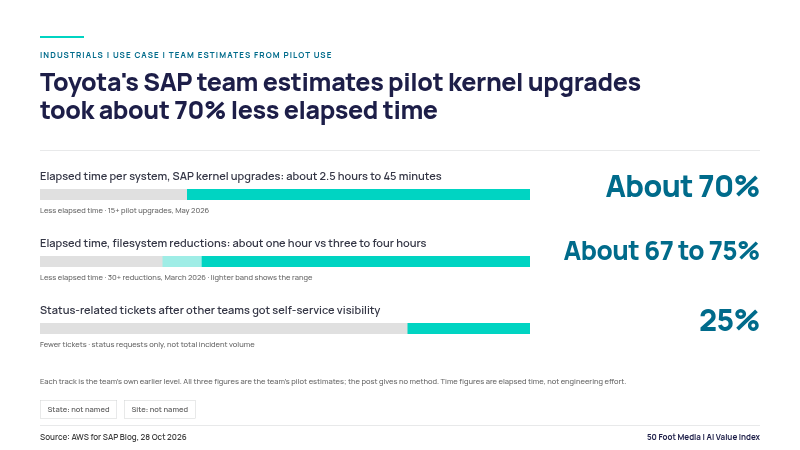
AIVI chart of the team's pilot estimates from the AWS for SAP Blog, 28 Oct 2026. Each track is the team's own earlier level; time figures are elapsed time, not engineering effort.
The write-up also records the time the automation tripped over itself. In early testing, a stalled stop-tracker's retry fired minutes after a successful AI-assisted upgrade had restarted the system, creating a conflicting stop action. The team added workflow locks per system and freshness windows on retries and approvals. A retry, the post says, "must re-check state before acting."
In 15+ pilot kernel upgrades, Toyota's SAP team estimates the work went from about 2.5 hours to 45 minutes of elapsed time per system, with an AI assistant whose production actions always wait for human approval.
Industrials
Key figures
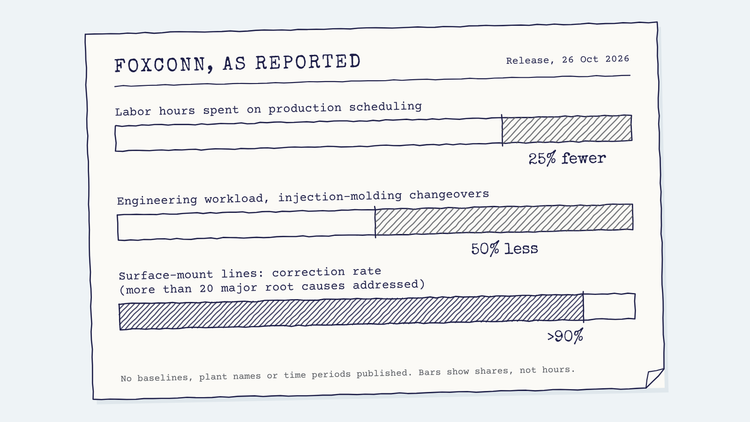
25% Fewer labor hours spent on production scheduling. Automated Production Scheduling · no baseline or plant given. (Foxconn release, 26 Oct 2026; tool name from NVIDIA case study)
50% Less engineering workload for injection-molding process changeovers. Setpoint optimization · no baseline or plant given. (Foxconn release, 26 Oct 2026; tool name from NVIDIA case study)
>90% Correction rate on surface-mount lines, more than 20 major defect root causes addressed. Correction rate not defined. (Foxconn release, 26 Oct 2026)
2.48x Faster training for 120-billion-parameter models vs previous H100-based systems. Measured by Foxconn · one trillion tokens in 12 days. (Foxconn release; NVIDIA case study)
All figures are reported by Foxconn, in its own release and an NVIDIA case study. Neither gives baselines, plant names, time periods or dollar values for the factory results.
Picture a factory on a Thursday. Someone is rebuilding the production plan for the third time. A part that was due on Monday has not turned up, and the week has to be taken apart and put back together again. Foxconn says AI has cut the labor hours it spends on production scheduling by 25%; the figure is its own, from a release dated 26 October, and comes with no baseline, no plant name and no time period.
Put plainly, that is fewer hours spent building and rebuilding the plan. The release does not say how many hours there were to begin with.
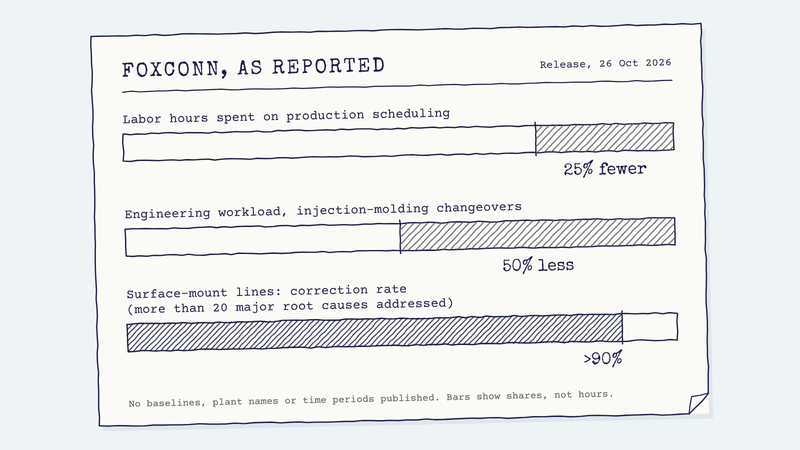
AIVI chart of figures from Foxconn's 26 Oct 2026 release. Foxconn gives no baselines, plant names or time periods; bars show the reported shares only.
The release, Foxconn Industrializes Intelligence and Scales the Future With AI Factories, lists two more results from the factory floor. It reports "50% less engineering workload for injection-molding process changeovers." A changeover, in our words, is the work of resetting a molding machine when it moves from one part to the next. And on the surface-mount lines, where components are placed onto circuit boards, it reports "More than 20 major defect root causes addressed, with a correction rate exceeding 90%." It does not say what a correction rate measures.
NVIDIA's case study, which the release links to, names the tools. The 25% belongs to "Automated Production Scheduling (APS)," which it says "reduced labor hours for plant scheduling by 25%." The 50% comes from "setpoint optimization" in injection molding. The release puts the defect results on "surface-mount production lines," plural; the case study says "SMT production line," singular. Neither says how many lines. NVIDIA sells the hardware and software the release says the AI factory runs on.
The rest of the release is about the machinery. FoxBrain, Foxconn's own large language model, is trained on NVIDIA DGX SuperPOD, and Foxconn reports "2.48x faster training for 120-billion-parameter models compared with its previous H100-based systems, processing one trillion tokens in 12 days." The case study footnotes that speedup "As measured by Foxconn." NVIDIA software "helps manage infrastructure and deploy AI agents across more than 200 facilities," the release says; the case study puts it as agents that "can be deployed across 200+ facilities." Neither says how many facilities run them, or which ones the scheduling, changeover or defect results come from.
One trillion tokens in 12 days and 25% fewer scheduling hours sit in the same release, at the same volume, and the reader is left to weigh them.
The value here is hours handed back: to whoever builds the plan, and to the engineer who resets the molding machine. That is how both sources put it, as fewer labor hours and less engineering workload. Neither says where those hours went.
What would let the Index grade this: the hours before and after, the plants where the scheduling and changeover results were measured, the period they cover, what the correction rate counts, and someone outside Foxconn and NVIDIA checking any of it.
A working life is mostly Tuesdays, and a fair few Thursdays spent putting Tuesday's plan back together. If Foxconn's figure holds, somewhere a scheduler is spending less of this week on the plan, and has a few of those hours back. Foxconn has not said where.
Foxconn says AI in its factories cut production-scheduling labor hours by 25% and changeover engineering workload on injection molding by 50%, and addressed more than 20 major defect root causes at a correction rate above 90%. The figures are its own, with no baselines or plant names.
Industrials
Key figures
6.33bn Won: Korean national project budget, AI excavator digital twin. About $4.4 million · runs to Dec 2029 · funding, not a result. (Aju Press; Seoul Economic Daily, 25 Oct 2026)
~1.2x HD Hyundai's claimed productivity vs manned operation. Vendor press release · no method, unit or baseline published. (HD Hyundai press release, 29 Apr 2026)
30% Performance improvement promised for the Swiss machine. Develon Europe's own text, not a quote · no measurement published. (Develon Europe, 2 Jul 2026)
None of these figures is a measured result. The budget is development funding to 2029; the 1.2x productivity and 30% performance figures are seller-side claims with no published method or crewed baseline.
HD Hyundai XiteSolution, the holding company for HD Hyundai's construction equipment business, has been picked to lead a South Korean government project, Aju Press reported on 25 October 2026. The project will build a digital twin for driverless excavators. The project has a total budget of 6.33 billion won, about $4.4 million by Seoul Economic Daily's conversion, and runs to December 2029. It's a plan, not a result, and no productivity figure comes with it. The only productivity numbers in the story belong to the machine HD Hyundai already has working: a 22-ton autonomous excavator digging a trench at a former quarry in Tuggen, Switzerland, for the construction group KIBAG. HD Hyundai's own press release says it can "achieve productivity levels about 1.2 times higher than those of manned operations." It doesn't say who measured that, on what task, or against which operator.
The money comes from Korea's industry ministry. The project's title, per Chosunbiz, is "Development of a high-precision simulation-based Digital Twin platform for artificial intelligence unmanned autonomous excavators." The consortium will rebuild in software how the machines work, including hydraulics, multibody dynamics and powertrains, and how equipment interacts with soil. It will then use that model to design excavators, wheel loaders and articulated dump trucks, and to train and check autonomy software before it reaches a site. HD Hyundai's part is to set standard specifications for the simulation parts database, validate in the field and evaluate operating scenarios. Its partners are Simji, Korea's construction equipment research institute, the Korea Institute of Industrial Technology and the Korea Construction Equipment Manufacturers Association. The company's case: testing driverless machines across varied real sites is slow, held back by equipment, conditions and safety. Checking them in a virtual space first, and comparing with real equipment data, should speed up development.
The machine behind the claims is a Develon DX225LC-7X fitted with Real-X. Develon is HD Hyundai's construction equipment brand. Real-X combines HD Hyundai XiteSolution's smart excavator platform with AI autonomy software from Gravis Robotics, a 2022 spin-off of ETH Zurich. HD Hyundai announced the handover on 29 April 2026 as the first time it had delivered an unmanned autonomous excavator to a working construction site. There's no operator in the cab and no remote control. Develon's European site says it works on KIBAG's private land under a technical supervisor, because autonomous machines in public spaces are "not yet clearly regulated."
Two seller-side claims, one machine
Two seller-side claims, one machine. Claimed gain, in percent, for the autonomous Develon DX225LC-7X at KIBAG's Tuggen site. HD Hyundai compares with manned operation; Develon names no comparison.
Develon Europe news page (2 Jul 2026, 'promising')
+30%
1.2 times is shown as about +20%, our reading. Neither source gives a unit of output, a time period or a crewed baseline. Claims, not measurements. Source: HD Hyundai press release (29 Apr 2026); Develon Europe (2 Jul 2026).
Two productivity claims are in circulation for this machine, and neither comes with a measurement. HD Hyundai's press release says about 1.2 times the productivity of manned operation. Develon Europe's account of the handover, in its own words right after quoting Urs Helbling, chief executive of Develon's Swiss dealer AG für Baumaschinen Schmerikon, describes the machine as "promising a 30% improvement in performance for trench excavation, earthworks and truck loading, along with a profitability of 100% or more." Read as 1.2 times the manned level, the first is about 20% more. The second is 30%, with no comparison named. Neither source says what was counted (cubic metres an hour, metres of trench a shift, cost per cubic metre), over what period, or against which operator. "Profitability of 100% or more" isn't defined. Both claims come from the manufacturer: HD Hyundai and its own Develon brand.
Even the job is described three ways. HD Hyundai's April release describes a trench "3m deep, 12m wide, and 1km long." Develon Europe in July and Chosunbiz on 24 October give 300 metres long, six metres wide and three metres deep. The Swiss trade outlet Schweizer Bauwirtschaft on 19 August gives 150 metres long, 17 metres wide and 3 metres deep. These may be different phases of one job. No source reconciles them, so there's no fixed unit of work to measure a productivity gain against.
The customer's account is the most useful. KIBAG chief executive Christoph Duijts told Schweizer Bauwirtschaft the company wants to prove autonomous crawler excavators can be used in real construction and work "safely and efficiently" (our translation from German). He said uses will be limited at first, and that finding "one or two simple applications that are economically interesting" would already be a lot. The outlet reported that the trial went well but showed snags: programming the controls took more work than expected. It reported no productivity figure.
For AIVI the claimed value here is output per machine and safer sites; no source claims fewer operators. Duijts said operators needn't worry: fully autonomous excavators are meant to take on monotonous work and ease the shortage of skilled workers, not replace staff. The Korean reports frame the national project around the same shortage and site safety, and an industry official told Chosunbiz that "For the time being, AI will play a role in assisting work rather than replacing operators." Still, this machine digs with nobody in the cab, so any gain comes from a supervisor overseeing a machine instead of an operator driving it. On the sources, the gains would go to the contractor, which gets more output from scarce skills, and to the manufacturer, which says it wants to bring the technology to mass production. No source says what the supervision costs or how many machines one person can oversee.
What would make this a graded case study: KIBAG or an independent party publishing what the Tuggen machine actually moved, in cubic metres an hour or a shift, with cost per cubic metre, downtime and human interventions, against a crewed excavator on the same kind of trench. The digital twin may one day help produce that comparison, since the project aims to compare virtual tests with real equipment data, but it runs to December 2029. Until then, no graded Index case backs this pattern.
HD Hyundai will lead a ₩6.33bn digital twin project for driverless excavators. Its Swiss machine is claimed at about 1.2 times manned productivity by HD Hyundai, and as 'promising a 30% improvement in performance' by Develon Europe, which names no comparison. Neither says how that was measured.
Healthcare – Providers
Key figures
83.2% MAI-DxO accuracy, hard NEJM cases. No test budget limit · text-only simulation · may not be the doctors' 56 cases. (Microsoft study in Science, abstract)
36.1% Generalist doctors, with references. Search and reference tools, 56 held-out cases · 22.3% without. (Microsoft study in Science, Results)
$2,241 Avg diagnostic cost per case at 80.9% accuracy. Budget-capped MAI-DxO · modeled test and visit prices, not billed. (Microsoft study in Science, Results)
All three figures are from Microsoft's own peer-reviewed study in Science (22 Oct 2026), measured in a controlled, text-only simulation, not in clinical practice. Costs are modeled from a hospital price list.
Microsoft's AI diagnostic system, MAI-DxO, got the right diagnosis on 83.2% of hard New England Journal of Medicine cases. Generalist doctors with search and reference tools got 36.1% on 56 of those cases, which had been held back from development. The paper doesn't say whether the 83.2% came from those same 56 cases or from all 304. The figures come from a peer-reviewed paper in Science, "Sequential diagnosis with language models," published in print on 22 October 2026. It was a simulation on written case records, not live patients, and the paper says so: "These comparisons do not establish superiority over specialists, multidisciplinary teams, or real-world clinical practice." All 15 authors work for Microsoft and hold equity in it. Microsoft paid for the study, and eight of the authors are named inventors on a Microsoft patent application for the evaluation method.
What was measured: the paper's benchmark, SDBench (Sequential Diagnosis Benchmark), turns 304 hard teaching cases published by NEJM, known as clinicopathological conference cases, into step-by-step encounters. A doctor or the AI starts from a short case summary and has to ask for history, examination findings and tests. A separate AI "gatekeeper" answers from the case record. An AI "judge" scores the final diagnosis against the published one, using a rubric written by physicians. A diagnosis counts as correct if management would be unchanged. Every test ordered adds an estimated cost, priced from the Kaiser Permanente Washington hospital chargemaster (its master price list), and questions to the patient count as a fixed doctor-visit fee. So the benchmark scores how you got to the answer, not just the answer. A second set adds 325 emergency department admissions from the MIMIC-IV-ED research database.
MAI-DxO isn't a new model. It's a software layer that directs an existing commercial language model, GPT-5 for the headline figures. Microsoft describes it as operating "like a panel of virtual physicians: each proposing diagnoses, selecting useful questions or tests, and challenging the emerging view." Averaged across the models tested, the paper says, that layer added 7.9 percentage points of accuracy on the NEJM cases and 4.4 on the emergency cases. TechCrunch reports GPT-5 alone scored 78.9% on the NEJM cases, so for GPT-5 the panel added about four points.
Diagnostic accuracy on hard NEJM cases
Diagnostic accuracy on hard NEJM cases. Share of cases diagnosed correctly in the text-only SDBench simulation, 0 to 100%. Blue: MAI-DxO. Teal: generalist doctors. Doctors were scored individually on 56 held-out cases. The paper doesn't say whether MAI-DxO's bars cover the same 56. Costs are modeled, not billed. Not a clinical result.
System or group (avg diagnostic cost)
Accuracy
MAI-DxO, no budget limit (avg diagnostic cost $5,431 a case)
83.2%
MAI-DxO, budget-capped (avg diagnostic cost $2,241 a case)
80.9%
Generalist doctors, with references (avg diagnostic cost $4,725 a case)
36.1%
Generalist doctors, no references (avg diagnostic cost $3,049 a case)
22.3%
Doctors were scored individually on 56 held-out cases. The paper doesn't say whether MAI-DxO's bars cover the same 56. Costs are modeled, not billed. Not a clinical result. Source: Science, 'Sequential diagnosis with language models' (22 Oct 2026).
The doctors were practicing generalists, in primary care and hospitals, each scored individually on part of the 56 held-back cases (an average of 36.4 cases each closed book and 34.8 open book). With no outside help, the "closed book" round, they got 22.3% right. With search and reference tools, the "open book" round, they got 36.1%. Looking things up helped but cost them: average time per case rose from 11.9 to 18.1 minutes, and diagnostic spend from $3,049 to $4,725 a case. The best single doctor reached 51.8% and was still beaten on both accuracy and cost. The comparison didn't include specialists matched to each case, or doctors working as a team.
A 2025 preprint of the same work, run on OpenAI's o3, reported 80% against 20% for physicians who were told not to use search engines or language models. The peer-reviewed figures replace those.
For AIVI the value here is accuracy and cost per case, not fewer doctors. Without a budget cap, MAI-DxO averaged $5,431 in diagnostic costs per NEJM case for its 83.2%, more than the $4,725 the doctors with references spent. With a budget cap it got 80.9% right at an average $2,241 a case, under half the doctors' figure, and 79.6% at $1,303. The doctors' costs come from the 56 held-out cases. As with accuracy, the paper doesn't say which cases the AI's costs cover, so both comparisons may be across different sets of cases. On the emergency cases it reached 80.3% at a mean $4,979 a case, against 46.8% at $3,400 for physicians with reference tools, and 73.2% at $2,634 with a budget cap. The authors frame the system as support, saying its structured reasoning "could augment human clinical judgment." The study didn't test doctors working with the AI.
The paper lists its own limits: NEJM cases "may overrepresent diagnostically challenging presentations," and neither data set includes healthy or benign visits. Doctors and AI alike worked through a text-based "oracle" rather than electronic health records or real patients, with no imaging, waveforms or pathology slides. The judge scores the diagnosis, not "therapeutic appropriateness, safety, or longitudinal management quality." The authors expect "the performance gap to narrow when comparing DxO with expert specialists or multidisciplinary specialist teams." Their summary: SDBench "measures diagnostic reasoning under idealized information conditions rather than bedside performance or patient outcomes."
TechCrunch reported the study on 22 October 2026 and noted that "Cases this complex are usually handled by specialists or physician teams, who weren't part of the comparison." TechCrunch doesn't test the figures. Microsoft's own post rounds them to 83%, 36% and 22% and calls MAI-DxO "about 3.7 and 2.3 times more accurate" than the doctors without and with references. The paper itself doesn't give those ratios, and they set the AI's score against the doctors' without saying the two cover the same cases. Microsoft also frames the work as a step toward what it calls medical superintelligence. That's Microsoft's goal, not a finding of the paper.
What would make this a graded case study: results from clinical use. Microsoft says it will run a prospective study with Beth Israel Deaconess Medical Center in Boston, where "patients will interact with the system directly, with performance measured against physicians' independent assessments." It gives no start date. A graded case would need accuracy, time or cost per case measured with clinicians using the system, against a stated baseline. Until then, no graded Index case backs this pattern.
In a peer-reviewed Science study run by Microsoft, its MAI-DxO system diagnosed 83.2% of hard NEJM cases correctly. Generalist doctors with reference tools got 36.1% on a 56-case subset; the paper doesn't say if the AI was scored on the same cases. A text-only simulation, not clinical practice.
Industrials
Key figures
−35% Layout schedule (Skanska report). Willow and Hopyard, Sutter Health · no baseline stated. (Dusty customer story, 'Project Acceleration')
−75% Rework, Skanska-wide estimate. Projects using Multi-Trade Layout vs unnamed similar projects · not specific to these two. (Dusty customer story, 'Installation with Fidelity to the Model')
80k+ Sq ft of multi-trade layout. Willow 60,000 sq ft + Hopyard first floor, over 20,000 sq ft. (Dusty customer story, summary tile and project list)
The two percentages are Skanska's figures as published by Dusty Robotics, which sells the robot, on an undated customer story. Only the 35% is tied to these two projects. CNBC repeated both on 12 Sep 2026 without testing them.
Skanska reports a 35% reduction in its layout schedule on two Sutter Health projects where a Dusty Robotics robot printed every trade's layout onto the floor in one pass. The figure comes from Dusty Robotics' own customer story, so the company that sells the robot published it. Under "Project Acceleration," the page says "Skanska realized a 35% reduction in layout schedule on these projects." The same page has a bigger number, 75% less rework. But that's Skanska's estimate for "projects leveraging Multi-Trade Layout" in general, not a figure for these two jobs. The page carries no date.
The two are sister projects, delivered under Integrated Project Delivery (IPD), a single contract under which the owner, designer and builder share risk and reward. The Willow building is a 60,000 sq ft adaptive reuse of an old telecom warehouse into an outpatient surgical center and medical office building, built to California's strict seismic codes. At the Hopyard building, Skanska built out the first floor, over 20,000 sq ft, as pediatric urgent care, physical therapy and imaging space. Dusty's summary tile puts the two together as ">80k sq ft" of multi-trade layout.
This is as much about getting the trades coordinated as it is about the robot. Dusty calls the process Multi-Trade Layout: "the GC and trades work together to coordinate layout as a digital deliverable as part of VDC. Then, everybody's layout is printed onsite in a single pass with Dusty." (VDC, virtual design and construction, means planning and coordinating the job in a shared 3D model before building it.) Joe Weisman, a Skanska project manager, says the team was "designing to an LOD 400 level", meaning the model was detailed enough to fabricate and install from, and that in the sterile corridor of the surgical center, "We had coordinated everything to a 1-inch tolerance." "With Dusty, we were able to reduce our risk because we laid out exactly what we had done in the model," he says. David Sharkey III, Skanska's senior project manager, sums up the pitch: "Less rework. Predictable schedules, predictable costs." On the schedule, Weisman says: "It was worth every penny… It allowed us to condense our layout schedule."
What Skanska reports, as published by Dusty
What Skanska reports, as published by Dusty. Bar length is the size of the reported reduction, 0 to 100%. Different measures and different scopes, not additive. Neither baseline is published.
Measure (scope)
Reported change
Layout schedule (Willow and Hopyard, no baseline stated)
−35%
Rework (Skanska-wide estimate, Multi-Trade Layout projects vs unnamed similar ones)
−75%
Different measures and different scopes, not additive. Neither baseline is published. Source: Dusty Robotics customer story (undated).
Read both numbers with care. The 35% is tied to "these projects", but the page doesn't say what it was measured against: the original plan, earlier projects, or an estimate of conventional layout. The 75% is not a figure for Willow and Hopyard. Dusty's page says Weisman "acknowledges that it's hard to estimate the amount of rework that didn't happen. But Skanska estimates that they've seen 75% less rework on projects leveraging Multi-Trade Layout, compared to similar projects using traditional layout." The page doesn't name those similar projects. It doesn't say how rework was counted (dollars, hours or number of fixes), and it publishes no baseline. And because the process bundles early coordination of every trade's layout with robotic printing, the page can't tell us how much of either gain comes from the robot and how much from the coordination.
How much of this is AI? Less than the label suggests. Dusty's FieldPrinter spec sheet (dated 21 Sep 2026) says the robot finds its position with a laser tracker aimed at surveyed control points. That's survey-grade measurement and geometry, not machine learning. The only part Dusty labels as AI is in its release notes, which say the FieldPrinter 2 "uses AI and machine learning to automatically identify obstacles". Neither Dusty page says which robot model or software ran at Willow or Hopyard, or when, so we couldn't verify that the machine-learning obstacle detection was used on these jobs.
CNBC repeated both numbers in Barbara Booth's 12 September 2026 article on construction robots. CNBC repeats the report and does not test it, so there is no independent corroboration.
Skanska's own article on AI lists Dusty among its "third-party AI vendors for specific use cases." But it reports on an ENR FutureTech 2024 panel whose speakers included Dusty's CEO, Tessa Lau, so it isn't independent of Dusty either. Neither Dusty's customer story nor CNBC calls the system AI. The outcomes Skanska reports are credited to the coordination workflow and the printing, not to obstacle detection.
What would make this a graded case study: Skanska or Dusty confirming the robot model, software and dates for Willow and Hopyard, plus a figure tied to the robot or its machine learning, such as layout hours or reprints avoided, with a stated baseline. Until then, no graded Index case backs this pattern. As Aaron Love of Oh Snap Layout, which uses robotic layout in homebuilding, told CNBC: "We're in that prove-it phase."
Skanska printed every trade's layout onto the floor with a Dusty Robotics robot on two Sutter Health jobs and reports a 35% shorter layout schedule. The figures come from Dusty, which sells the robot. The gain is credited to a coordination workflow that includes the robot; the AI's part is small.
Industrials
Key figures
18 shipyards worldwide, Fincantieri
23,000+ employees, Fincantieri
0 linked graded cases, No measured outcome yet
Company scale as given in the AIVI record. The EY article reports no outcome figures for the program, which is why this is a use case and not a case study.
If there is a sweet spot for advanced AI and robotics, it has to be robots doing jobs that wreck the human body, are repeated all day, and from time to time result in death.
And so it is that the AI Value Index team, which is me, greeted the arrival of a potential robotics case study from EY with great enthusiasm. How did it pan out?
Close, but no cigar.
A couple issues to consider as we interrogate the EY story. First, surprise, surprise, there is a shortage of skilled labor to perform hard, dull, and dangerous work. Second, the U.S. is pushing shipbuilders to ramp up production so it has more vessels to ferry weapons and ammo into combat zones.
The answer, of course, is robots. EY attempted to highlight the answer in action with a recent article about a program with NVIDIA and Fincantieri, the latter being an Italian player in the shipbuilding industry. They operate 18 shipyards worldwide and have over 23,000 employees, none of whom are robots but all of whom are future retirees.
The goal of the program is unclear and thus our hope for a case study perishes with EY's use of vague terms about how "humanoid robotics can play a meaningful role in addressing some of the most persistent challenges facing heavy industry."
But the article substantiates the robotics use case and shows how companies like Fincantieri are taking "tangible steps toward exploring how humanoids can support hazardous and repetitive tasks."
If this ends up meaning that Fincantieri has taken steps to reduce "human exposure to risk while maintaining productivity in complex operational environments" then we are likely to get more ships and maybe some of those unexposed humans can become sailors.
370,000+ lexington submissions, As of year-end 2025
+26% submissions, year over year, Lexington business, 2025
+35% submit-to-bind ratio, Since rollout to Lexington Middle Market Property
500,000 submission ambition, Lexington, by 2030 · set at Investor Day
AIG's own figures, quoted in the AIVI record from its 2025 Annual Report. Not independently measured.
We at the AI Value Index wanted quite badly for this to be a case study. Alas, it is but a use case, albeit a critically important one.
Earlier this year, AIG noted in its 2025 Annual Report that it is scaling underwriting with its AIG Assist tool.
The claim: AIG Assist enabled "our underwriters to review more submissions. At Investor Day, we set an ambition of reaching 500,000 submissions in our Lexington business by 2030. As of year-end 2025, we have already surpassed 370,000 submissions, a 26% increase year-over-year. Since we began the rollout to Lexington Middle Market Property, the submit-to-bind ratio improved 35%, reflecting notable productivity gains."
Like me, you may not know why insurance lingo uses the word "bind" to mean "convert" but that is neither here nor there. AIG claims to have improved its conversion of submissions to underwriting into live policies by 35%.
This is exciting stuff. No, really. So exciting that we asked the next logical question. Did AIG fire a bunch of underwriters?
AIG Assist reviews. It does not bind. A person still says yes. That is the model that does not bind, and in not doing so it leaves the underwriter on the desk.
And that is super exciting because, if accurate, it is validation of the possibility that AI will deliver productivity gains without reducing tax revenues due to pesky job cuts.
~1/3 providers with ambient ai access, “Around a third”, per health tech experts cited by advisory.com
−15% time composing notes, Ambient-scribe users vs. look-alike non-users · UChicago Medicine
1 linked graded case, Mercy · Dragon Copilot for nurses
Figures as reported in the AIVI record. The 15% is from the JAMA Network Open study the record links; the access estimate is a claim quoted by advisory.com.
We've all been to the doctor but how many of us understand the clinical workflows our healthcare providers perform? Like a lot of professionals, they take notes. AI has proven to be excellent and improving note taking. Sounds like a perfect match. But how's it working out?
A Daily Briefing on advisor.com that was published earlier in the year cites a claim by health tech experts, that "around a third of providers currently have access to ambient AI technology, and adoption will likely grow rapidly over the next few years, especially as providers increasingly prioritize work-life balance."
The part that holds up is time. As in clinicians using an ambient-scribe tool spending about 15% less time composing notes. That's what researchers at UChicago Medicine found in a 2025 study in JAMA Network Open. The effort compared AI enabled clinicians to look-alike non-users, reading an EHR clock. 15% is a solid result, particularly when you think about the long-term impact of saving nearly 3 mins of time writing notes on every patient, every week, for months and years. Plus, adoption will likely improve utilization, with users getting better at how they use the tool as they use it regularly over time.
Still, as I noted in a previous article, the use case draws attention to the critical role of the clinician and the nuances of clinical workflows. Ambient note taking is no substitute for reviewing the takeaways and figuring out what to do next. I expect we will see more friction develop when workflows attempt to integrate AI tools, especially in healthcare.