SignalCross-industryData story
A 50-Basis-Point Forecast
J.P. Morgan puts its forecast for growth in U.S. output per hour 50 basis points above its pre-AI baseline, at 2.2%. Hold that for 15 years, it says, and the economy ends up 7% to 8% larger than otherwise. It is a forecast, not a measurement, with the biggest gains in the 2030s and beyond.

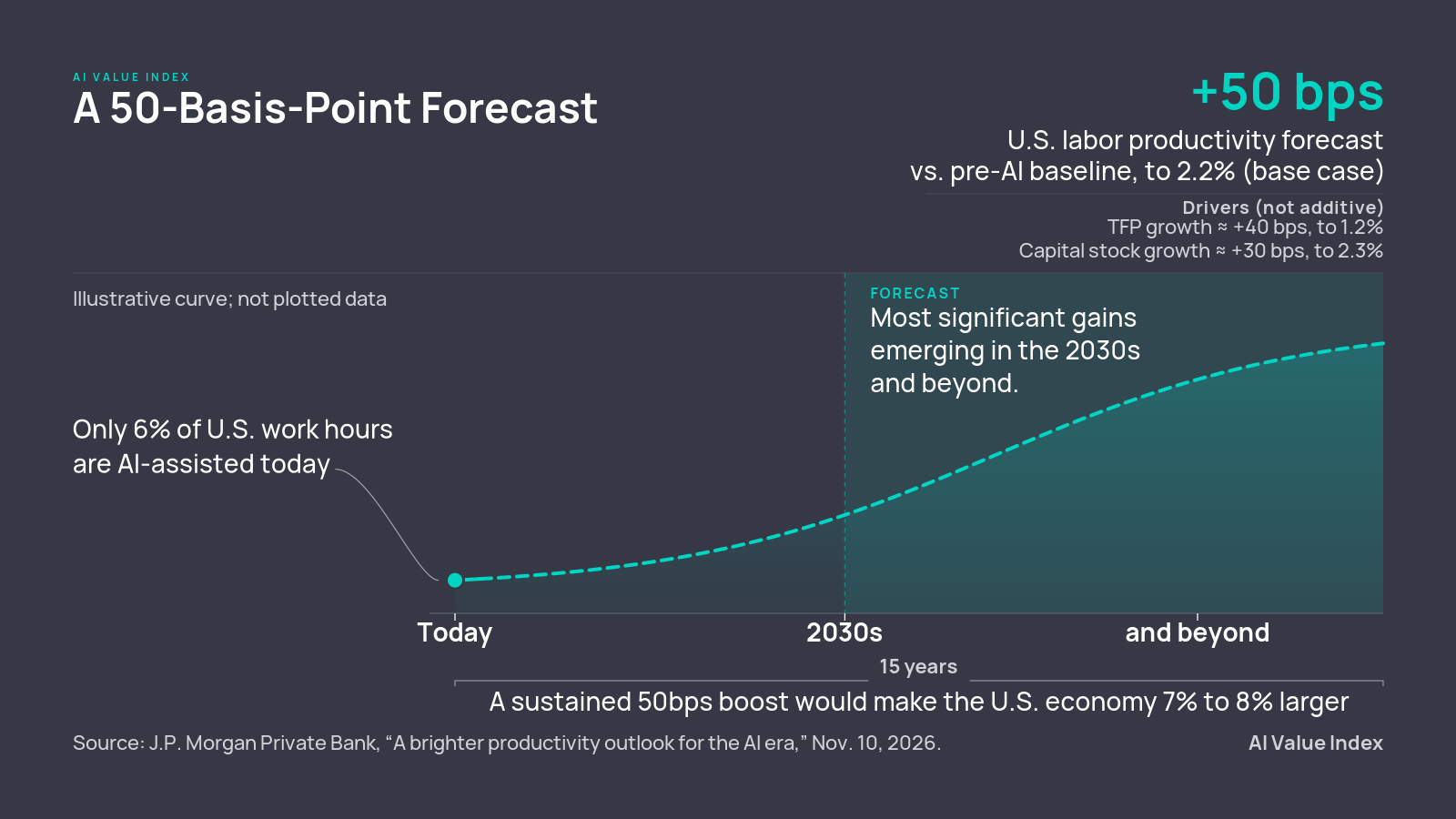
We are seeing a claim from J.P. Morgan about U.S. output per hour worked and its long-term impact on the U.S. economy. They expect output per hour to grow 50 basis points faster than its pre-AI baseline, to 2.2%. If that boost holds for 15 years, by the bank's math that would make the U.S. economy 7% to 8% larger than it otherwise would have been.
It is worth reading slowly. The 50 basis points is a base case, built into the bank's Long-Term Capital Market Assumptions. Nobody has watched it happen, and the bank does not pretend otherwise: "To date, we've seen only faint signals of AI's impact on productivity."
The bank builds the number from two parts. The first is efficiency. AI "makes existing work more efficient, enabling the same people and machines to produce more (total factor productivity, or TFP)." On TFP, the bank estimates AI will boost growth "by roughly 40 basis points (bps) above the pre-AI norm, to 1.2% annually." The second is money spent. Investment in tools and infrastructure lifts "U.S. capital stock growth by about 30bps, to 2.3% per year."
None of it comes fast. The bank expects the boost to be gradual, "with the most significant gains emerging in the 2030s and beyond." It is early yet: "Only 6% of U.S. work hours are AI-assisted today."
For the AI Value Index, this signal belongs at the national layer: a claim about output per hour across the U.S. economy, not one company's workflow. It is a forecast, not a measurement. No one has shown that 50-basis-point lift, and the bank does not say anyone has. A round number with a long horizon is the kind that gets repeated before it gets checked. Evidence would be realized growth in output per hour, shown with method. The test is plain enough, and it will take time: whether anything close to those 50 basis points turns up in the 2030s.
Get new AI Value Index records in your inbox.
Subscribe