95% Cut in loan underwriting cycle time. Sidhu, CEO; no baseline given. (Q3 2026 earnings call, Oct 23)
76K Estimated hours saved, cumulative. Employee self-reported survey, not validated. (Sidhu on the Q3 call; bank footnote in investor deck)
>90% Cut in account opening time vs other banks. Sidhu: complex commercial accounts in minutes, not days. (Q3 2026 earnings call, Oct 23)
A loan is paperwork before it's money. At Customers Bancorp, the paperwork moves faster now.
On the bank's Q3 earnings call on October 23, CEO Samvir Sidhu said AI-powered loan underwriting changed the work. "The cycle time for this process is down 95%," he said. "This will allow the same team to handle significantly more loan throughput." He gave no baseline.
He gave a running total too. "Cumulative estimated hours saved have now grown to 76 thousand," Sidhu said.
Every banker knows the feeling. The deal is ready and the paperwork isn't. Those waiting hours go somewhere else now.
Look at the word "estimated." The bank's own footnote says where it comes from: employees surveyed on their own time saved, not validated. That's honest of them, and it's the reason the index can't do more than report it.
The bank also rebuilt how it opens commercial deposit accounts and piloted it in 10 weeks. On the call, Sidhu said the new process opens complex commercial accounts in minutes, compared with days at other institutions. "That represents an >90% reduction in cycle time." The comparison is with other banks, not its own old process.
What the Index says: an on-record claim from the top of the bank, with no baseline, and hours counted by the people who saved them. Worth reporting. Worth checking.
Same team, more loans. That's the claim. The index will believe it when the throughput shows up.
A loan is paperwork before it's money. At Customers Bancorp, the paperwork moves faster now.
Financial Services
Key figures
~2/3 Survey respondents actively deploying AI. Most of those report gains · self-reported. (PwC / ULI, Emerging Trends in Real Estate 2027)
#1 Disruptive force through 2029, as respondents rank it. Ahead of construction costs, geopolitics and grid limits · no percentage given. (PwC / ULI, Emerging Trends in Real Estate 2027)
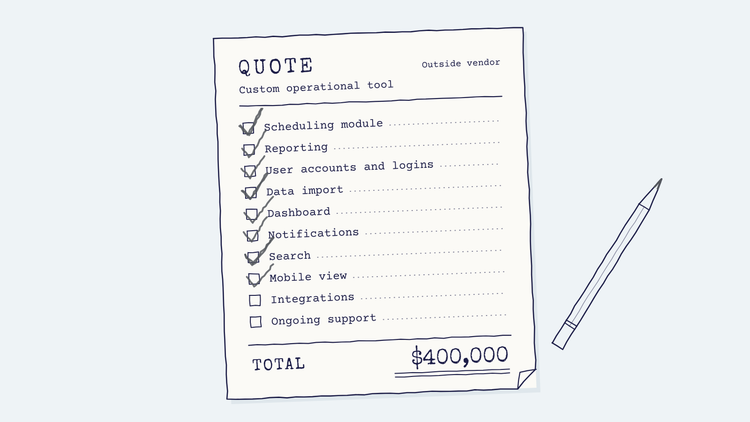
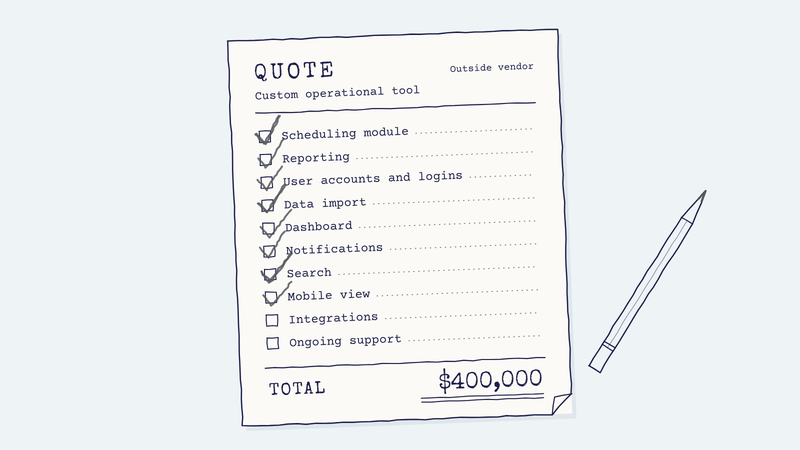
$400,000 Outside vendor's quote for a custom operational tool. Economy extended-stay operator · a quote, not spend. (PwC / ULI interviews)
~80% Of that tool built by a team member with no formal coding background. Internal cost: "a fraction" · no figure given. (PwC / ULI interviews)
Survey shares and anonymous interview accounts from PwC and the Urban Land Institute. None is a measured outcome. The chapter gives no survey size, no percentage for the disruption ranking and no internal build cost.
In a real estate report for 2027, several firms describe "building custom applications using AI-assisted coding that replace vendor software at significantly lower cost." One example: an economy extended-stay operator reports that a team member with no formal coding background produced roughly 80 percent of a custom operational tool. An outside vendor had quoted $400,000 for it. The internal build cost "a fraction of that amount," and the report calls it "debatable" whether that is "a scalable model or an exceptional case."
Illustration, not PwC/ULI data. Only the $400,000 quote total comes from the report; the line items and ticks are invented.
The story comes from Emerging Trends in Real Estate 2027, from PwC and the Urban Land Institute, in a chapter called "AI and the Human Premium." Almost two-thirds of the report's survey respondents are now actively deploying AI, it says, "and most of those reporting productivity gains." An even larger share rank AI as the single most disruptive force facing the industry through 2029, ahead of construction costs, geopolitical instability, and energy and power grid constraints. The report gives no percentage for that ranking.
Using it is not the same as doing it well. "Everybody is talking about AI, but very few people are actually doing it well. It is painful and slow and expensive," the CEO of a national extended-stay operator says in the report. PwC and ULI say that line "may be the most representative observation in this year's interviews."
The report is careful with its best story. Firms reporting results like the $400,000 one "tend to have strong data infrastructure and executive commitment to the process," it says. Building in-house also carries ongoing costs in maintenance, updates, and technical support "that are not always apparent at launch." What the internal tool cost to build, and what it costs to keep running, is not in the report.
Every office is full of paper, screens and cabinets, and the most interesting thing in it is never the filing cabinet. It's whoever is sitting there. The report turns to people too. "Hoteling did not work. Hot desking did not work," a senior leasing executive at a Manhattan office REIT says in the report. "What works is giving people a reason to come in that they cannot replicate at home. And that reason is almost always other people."
That is what the report calls the human premium: judgment, relationships and service. As AI increasingly supports analytical and operational tasks, it says, "the ability to exercise judgment, build relationships, and deliver differentiated service and experiences remains an important source of value across the industry." It is just as plain about the limits. The link between service investments and financial performance "is difficult to isolate precisely," and preferences for human versus automated interaction vary by customer, activity and property type.
What would make this a stronger Index signal: the survey's size and question wording from the full report, a definition of the gains respondents report, and a named firm putting numbers on a build like the $400,000 one, including what it cost and what it costs to maintain. Until then, it is a useful read on where the industry thinks value sits, not a measured result. The chapter's own last line keeps the caveat standing: executives who stay clear about the difference between implementing technology and generating measurable value "will be better positioned than those who conflate adoption with advantage."
PwC and ULI's Emerging Trends in Real Estate 2027 finds almost two-thirds of survey respondents actively deploying AI, and an even larger share ranking it the most disruptive force through 2029. The report still sees judgment, relationships and service as an important source of value.
Financial Services
Key figures
370,000+ lexington submissions, As of year-end 2025
+26% submissions, year over year, Lexington business, 2025
+35% submit-to-bind ratio, Since rollout to Lexington Middle Market Property
500,000 submission ambition, Lexington, by 2030 · set at Investor Day
AIG's own figures, quoted in the AIVI record from its 2025 Annual Report. Not independently measured.
We at the AI Value Index wanted quite badly for this to be a case study. Alas, it is but a use case, albeit a critically important one.
Earlier this year, AIG noted in its 2025 Annual Report that it is scaling underwriting with its AIG Assist tool.
The claim: AIG Assist enabled "our underwriters to review more submissions. At Investor Day, we set an ambition of reaching 500,000 submissions in our Lexington business by 2030. As of year-end 2025, we have already surpassed 370,000 submissions, a 26% increase year-over-year. Since we began the rollout to Lexington Middle Market Property, the submit-to-bind ratio improved 35%, reflecting notable productivity gains."
Like me, you may not know why insurance lingo uses the word "bind" to mean "convert" but that is neither here nor there. AIG claims to have improved its conversion of submissions to underwriting into live policies by 35%.
This is exciting stuff. No, really. So exciting that we asked the next logical question. Did AIG fire a bunch of underwriters?
AIG Assist reviews. It does not bind. A person still says yes. That is the model that does not bind, and in not doing so it leaves the underwriter on the desk.
And that is super exciting because, if accurate, it is validation of the possibility that AI will deliver productivity gains without reducing tax revenues due to pesky job cuts.