SignalCross-industryData story
The Data-Center Pipeline, and What It Does Not Prove
Commercial electricity sales are forecast to exceed residential sales in 2026, a first in EIA annual data back to 1990. The construction queue is already large. Neither figure is a measured productivity result.

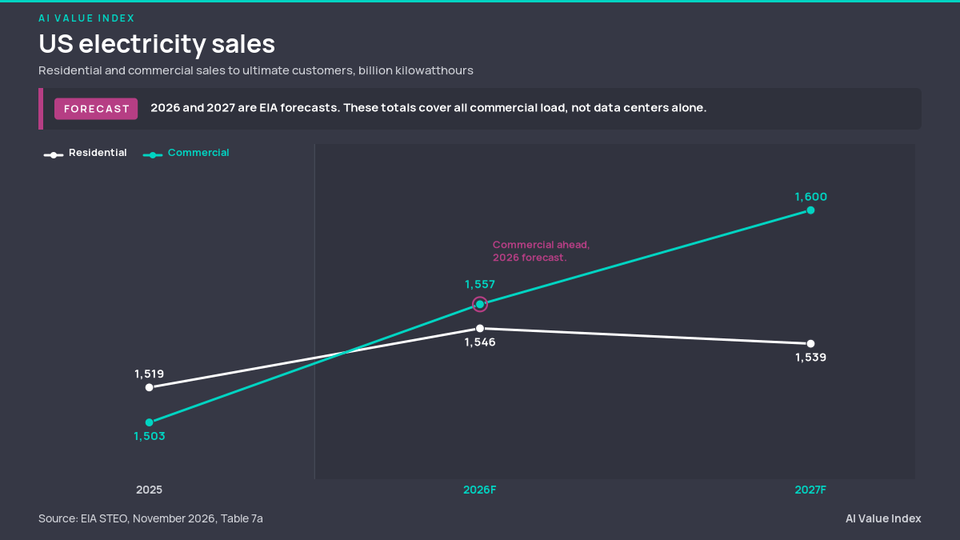
The United States is on track for a first in EIA annual sales data back to 1990: commercial electricity sales are forecast to exceed residential sales in 2026. The November Short-Term Energy Outlook still has households slightly ahead in 2025, at 1,519 billion kilowatthours against 1,503 billion commercial. For 2026 it forecasts 1,557 billion commercial against 1,546 billion residential.
Commercial sales already exceed residential sales in 23 states and the District of Columbia. Texas, Ohio, Nevada, and South Dakota moved ahead in 2025. In Virginia, commercial customers accounted for about 59 percent of 2025 retail sales. These figures cover all commercial load, not data centers alone, and EIA says some recent shifts reflect better reporting of data-center and cryptocurrency operations. Illinois, Maryland, and Minnesota went the other way in 2025.
The Electric Power Research Institute's February 2026 Powering Intelligence report put data centers at 4 to 5 percent of US electricity use and projected 9 to 17 percent by 2030, depending on how much of the announced pipeline comes online.
The Index's close-read layer, last checked November 16, 2026, now holds 18 sourced records in Nebraska, Missouri, and Mississippi: 6 opened or operating, 3 under construction, and 9 announced. Four new Missouri sites are not shown as under construction, including an Amazon Web Services facility announced for New Florence and two Franklin County sites rezoned on September 15, 2026.
Cleanview reported 58 gigawatts under construction on November 17, after 38 gigawatts of starts in the prior 12 months, and 580 buildings under construction on 284 campuses as of the November 19, 2026 map update. Starts slowed in the third quarter, to 8.4 gigawatts from a record 11.7 gigawatts in the spring. In October alone, developers started 4.6 gigawatts, nearly double October 2025. Cleanview also says nine states with a promised or imposed pause hold 41 percent of planned US capacity.
On October 28, American Electric Power raised its five-year capital plan from $78 billion to $100 billion and cited about 35 gigawatts of load under signed firm take-or-pay agreements. On October 29, WEC Energy Group announced a $47.5 billion capital plan for 2027-2031. On November 5, DTE Energy said it plans about $44 billion of utility investment over the next five years, including spending to serve data-center demand.
Capacity is not the same as proven value. The AI Value Index will keep grading measured productivity results, not megawatts. The summer slowdown and the promised pauses are a watch item, not a verdict.
How to read this: The electricity figures are EIA sales data and a 2026-2027 forecast, covering all commercial load, not data centers alone. The 18 close-read records are infrastructure context and are not graded. Cleanview's gigawatt and building counts are that firm's public top-line figures, dated as cited. Source: Cleanview. That credit does not mean Cleanview endorses this article. Utility capital plans are company figures from American Electric Power's October 28 earnings materials, WEC Energy Group's SEC-filed November 2026 investor presentation, and DTE Energy's November 5 news release.
Get new AI Value Index records in your inbox.
Subscribe