AI Value Index: AI Trends, Use Cases and Case Studies by Industry
Signal
Key figures
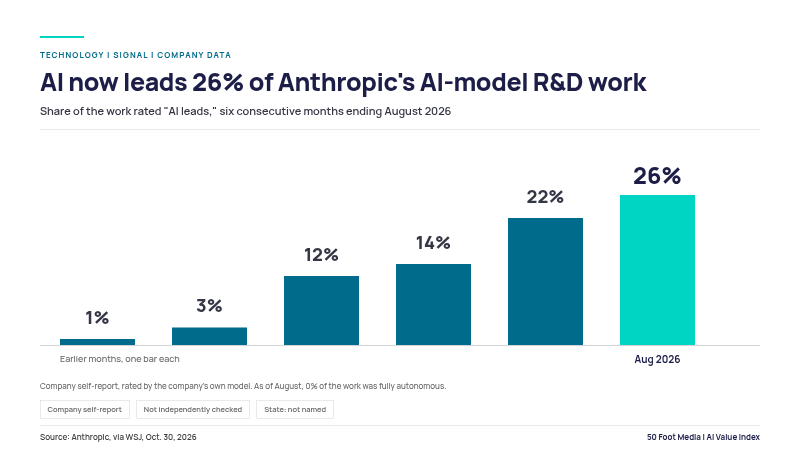
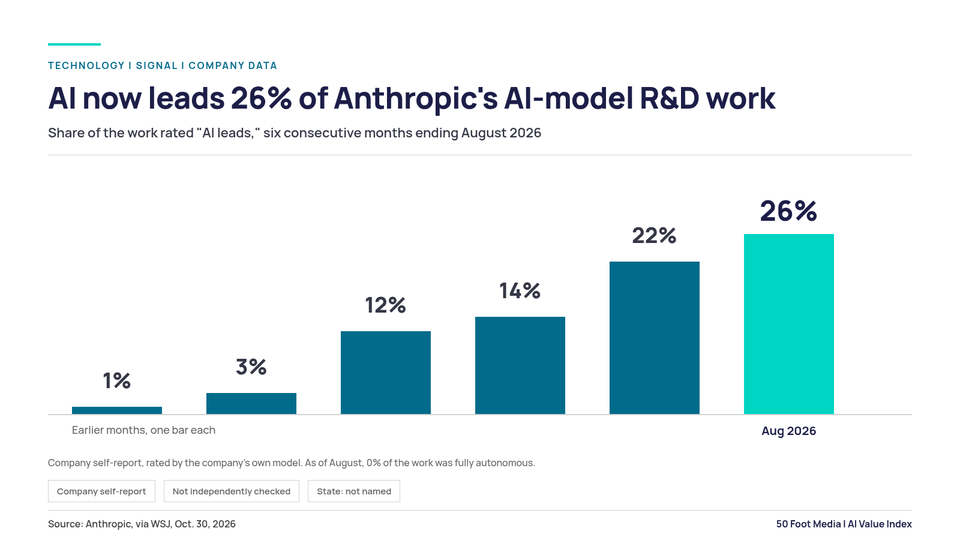
26% Of Anthropic's AI-model R&D work led by AI in August 2026. Up from 1% in early 2026, by the company's own index. (Anthropic; WSJ chart, 30 Oct 2026)
0% Of the work fully autonomous, as of August. Company chart note. (Anthropic; WSJ chart, 30 Oct 2026)
Anthropic's own figures about its own work, rated by its own model. No outside party has checked them.
AI companies sell tools that take on other people's work. Anthropic has now published a count of how much of its own work those tools lead.
In a post on measuring AI development inside frontier labs, Anthropic rates its model research and development tasks on an automation scale from Epoch AI. At the level it calls "leads," AI "can complete most of the task end-to-end from a high-level prompt, while the human supervises." The company's chart, also published by The Wall Street Journal on October 30, puts that share at 1% in early 2026, then 3%, 12%, 14% and 22%, and 26% in August.
None of the work runs on its own. The company says "Claude is not operating fully autonomously for any measured subset of AI R&D work." The Journal's chart note puts it plainly: "As of August, 0% of AI R+D is fully autonomous."
Chart built from Anthropic's own figures, as published by the company and in The Wall Street Journal on Oct. 30, 2026. No outside party has checked them.
Anthropic's index weights each kind of task by the staff time spent on it. It does not report hours saved, output or cost. It measures who leads the work, not what the work is worth.
Anthropic says it plans to "embed independent third-party evaluators" at the company. Until those checks report, the 26% is the company's own count of its own work.
Anthropic says AI now leads 26% of its own AI-model research and development work, up from 1% in early 2026. None of it was fully autonomous as of August, and no outside party has checked the count.
56% Cut in dispatchers' call load in the past 30 days, as KAIT reports. No method or baseline published. (KAIT, 29 Oct 2026)
Nearly 5,000 Calls Lezle answered from Sept. 29 to Oct. 28. Dispatchers say it resolves more than half of them itself. (KAIT, 29 Oct 2026)
Figures from KAIT and dispatchers, not a city or county document. Non-emergency lines only; Lezle never answers 911.
At a 911 center, a call about a records request and a call about a fire can ring at the same time, and on some shifts there are only three people to answer them. Jonesboro, Ark., has put a machine on the first kind of call so its dispatchers can take the second.
The machine is an AI call taker the center named Lezle. Local station KAIT reported on Oct. 29 that Lezle, "the system answering non-emergency calls in Craighead County for nearly two months, has cut dispatchers' call load by 56% in the past 30 days." KAIT adds: "From Sept. 29 to Oct. 28, Lezle answered nearly 5,000 calls. Dispatchers say it resolves more than half of them itself, especially when people need help with clerical matters, such as records or warrants, then transfers callers to the correct person."
The center is run by the City of Jonesboro. According to the city, Jonesboro E911 dispatches for the Craighead County Sheriff's Department and police and fire departments across the county, "providing non-emergency and emergency 9-1-1 services to the citizens of Craighead County." When Lezle started in September, KAIT reported that "staffing limitations mean that some shifts run with as few as three dispatchers on duty" and that the center employs 22 full-time dispatchers working 12-hour shifts.
Lezle does not answer 911. "She's never going to answer a 911 call," training coordinator Cristy Hundley told KAIT in September. "And if she determines that a non-emergency call is actually an emergency, she's going to send it straight to a dispatcher right then." Dispatcher Terra Summers told KAIT in October that trigger words such as "emergency," "breathing" or "fire" immediately transfer a caller to a live dispatcher. On the non-emergency lines, KATV reported that Lezle can "text callers information and direct them to a website or online form," or enter a non-emergent call "into the system for an officer to be dispatched," and that "Live dispatchers will be monitoring the system at all times."
For the people on the floor, the point is time. "We're trying to run a radio while also answering the 911s, while also answering the non-emergencies," dispatcher Savannah Tinsley said in September. "It relieves a lot of stress and extra workload." In October, Summers put it this way: "70 hours might not sound like a lot, but when you think about the majority of calls taking five minutes or less, that's a lot of calls, so she's definitely made a positive impact." KAIT does not say what period the 70 hours covers.
It has made mistakes. Early on, Summers said, Lezle told a caller reporting an accident, "Please go online to file this accident report." "Well, with any car accident, we're going to send an officer," she said. Dispatchers report errors to upper administration, which fixes them or sends them to the programmer.
The software comes from Prepared by AXON. When the city council approved it in January, KAIT reported that "The software carries a price tag of around $200,000 per year," and that E-911 Director Ronnie Sturch said savings from dropping other services, including a call tree and a translation service, would offset it. Deputy director Mellenee Bennett told KAIT that "The AI program is not designed to replace any dispatcher."
Jonesboro resident Nicholas Sides, who has not called Lezle, told KAIT he is wary of AI but watching. "I just think that we need to use it in the right ways," he said. A published count from the city, with its method, is what would show whether the 56% holds.
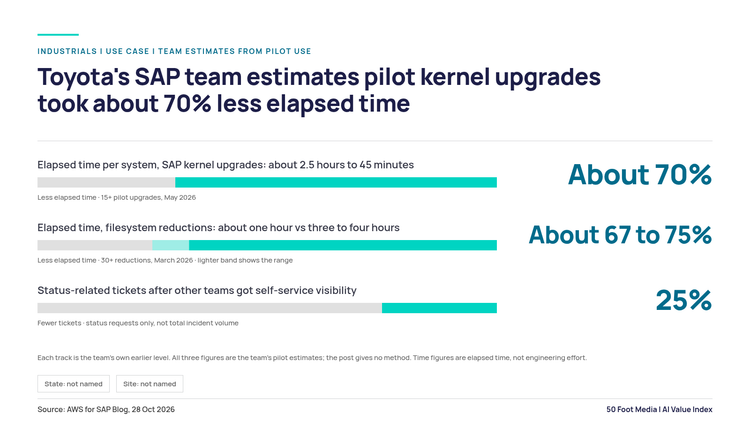
About 2.5 hours to 45 minutes Estimated elapsed completion time per system for SAP kernel upgrades, about 70% less. 15+ pilot upgrades, May 2026. (AWS for SAP Blog, 28 Oct 2026)
About one hour Estimated elapsed time for filesystem reductions, compared with three to four hours previously, about 67 to 75% less. 30+ reductions, March 2026. (AWS for SAP Blog, 28 Oct 2026)
25% Estimated reduction in status-related tickets after other teams got self-service visibility. Status requests only. (AWS for SAP Blog, 28 Oct 2026)
Published on AWS's blog by two AWS staff, co-authored with Toyota Motor North America's SAP team, and built on the AWS services it describes. Every figure is the team's own estimate from pilot use and has not been independently verified.
SAP maintenance leaves no room for improvising. Application servers drain before central services stop, shared databases must not be stopped while the applications that depend on them are still running, and everything comes back up in a set order. Engineers on Toyota Motor North America's SAP team used to work through that runbook while moving between terminals, SAP GUIs, spreadsheets and AWS consoles.
During the pilot, that job changed. In an AWS blog post published October 28, 2026 and co-authored with the team, Toyota describes BasisPilot, an in-house operations platform with an AI assistant built in. It covers "20 SAP systems on 60+ Amazon EC2 hosts across development, test, stage, and production environments." The key line: "During pilot use, the engineer's role shifted from executing a manual runbook to supervising an approved workflow."
The risk with automation is rarely that the tool is too weak. It is switching it on before anyone has built a way to stop it. Toyota's team built the stop first. Viewer roles stay read-only. "Production actions, multi-tenant database hosts, and destructive operations always create a pending approval instead of executing." Before a kernel upgrade, the assistant shows a pre-check with Proceed and Cancel buttons, and at that point "no change has been made." If startup verification fails, the workflow restores the backed-up kernel. "Generated text never becomes a shell command." In the kernel upgrade, the engineer no longer carries out every step. The engineer decides whether the steps run at all.
That order was deliberate. "I started with the decisions a Basis engineer has to make before touching a system: what evidence do I trust, what has to happen in what order, and what should stop me," says Manish Kumar, a senior SAP product owner on the team.
The results so far are the team's estimates from the pilot. Across 15+ kernel upgrades in May 2026, the work went from about 2.5 hours to 45 minutes of elapsed time per system, "a reduction of about 70%." Across 30+ filesystem reductions in March 2026, elapsed time came to approximately one hour, compared with three to four hours before, about 67 to 75% less. The team also estimates "at least 20% less time spent gathering and analyzing operational information," and reports "an estimated 25% reduction in status-related tickets" after other teams were given self-service visibility.
AIVI chart of the team's pilot estimates from the AWS for SAP Blog, 28 Oct 2026. Each track is the team's own earlier level; time figures are elapsed time, not engineering effort.
The write-up also records the time the automation tripped over itself. In early testing, a stalled stop-tracker's retry fired minutes after a successful AI-assisted upgrade had restarted the system, creating a conflicting stop action. The team added workflow locks per system and freshness windows on retries and approvals. A retry, the post says, "must re-check state before acting."
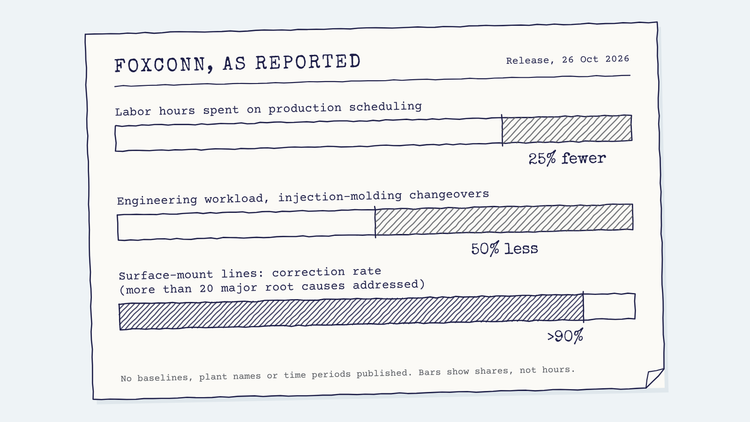
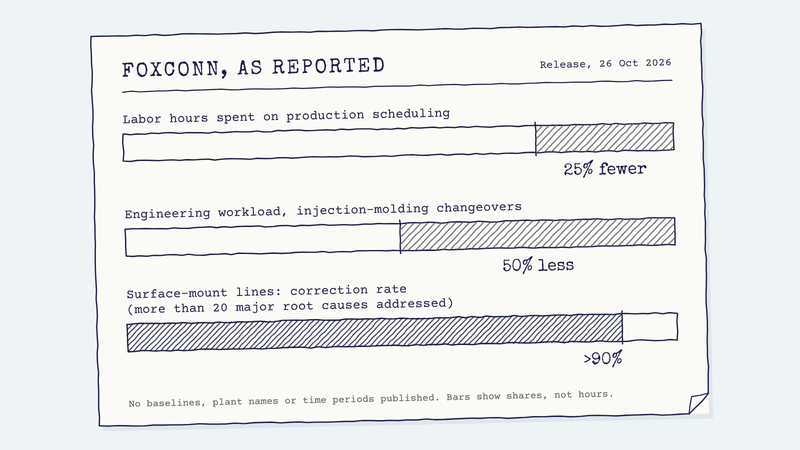
25% Fewer labor hours spent on production scheduling. Automated Production Scheduling · no baseline or plant given. (Foxconn release, 26 Oct 2026; tool name from NVIDIA case study)
50% Less engineering workload for injection-molding process changeovers. Setpoint optimization · no baseline or plant given. (Foxconn release, 26 Oct 2026; tool name from NVIDIA case study)
>90% Correction rate on surface-mount lines, more than 20 major defect root causes addressed. Correction rate not defined. (Foxconn release, 26 Oct 2026)
2.48x Faster training for 120-billion-parameter models vs previous H100-based systems. Measured by Foxconn · one trillion tokens in 12 days. (Foxconn release; NVIDIA case study)
All figures are reported by Foxconn, in its own release and an NVIDIA case study. Neither gives baselines, plant names, time periods or dollar values for the factory results.
Picture a factory on a Thursday. Someone is rebuilding the production plan for the third time. A part that was due on Monday has not turned up, and the week has to be taken apart and put back together again. Foxconn says AI has cut the labor hours it spends on production scheduling by 25%; the figure is its own, from a release dated 26 October, and comes with no baseline, no plant name and no time period.
Put plainly, that is fewer hours spent building and rebuilding the plan. The release does not say how many hours there were to begin with.
AIVI chart of figures from Foxconn's 26 Oct 2026 release. Foxconn gives no baselines, plant names or time periods; bars show the reported shares only.
The release, Foxconn Industrializes Intelligence and Scales the Future With AI Factories, lists two more results from the factory floor. It reports "50% less engineering workload for injection-molding process changeovers." A changeover, in our words, is the work of resetting a molding machine when it moves from one part to the next. And on the surface-mount lines, where components are placed onto circuit boards, it reports "More than 20 major defect root causes addressed, with a correction rate exceeding 90%." It does not say what a correction rate measures.
NVIDIA's case study, which the release links to, names the tools. The 25% belongs to "Automated Production Scheduling (APS)," which it says "reduced labor hours for plant scheduling by 25%." The 50% comes from "setpoint optimization" in injection molding. The release puts the defect results on "surface-mount production lines," plural; the case study says "SMT production line," singular. Neither says how many lines. NVIDIA sells the hardware and software the release says the AI factory runs on.
The rest of the release is about the machinery. FoxBrain, Foxconn's own large language model, is trained on NVIDIA DGX SuperPOD, and Foxconn reports "2.48x faster training for 120-billion-parameter models compared with its previous H100-based systems, processing one trillion tokens in 12 days." The case study footnotes that speedup "As measured by Foxconn." NVIDIA software "helps manage infrastructure and deploy AI agents across more than 200 facilities," the release says; the case study puts it as agents that "can be deployed across 200+ facilities." Neither says how many facilities run them, or which ones the scheduling, changeover or defect results come from.
One trillion tokens in 12 days and 25% fewer scheduling hours sit in the same release, at the same volume, and the reader is left to weigh them.
The value here is hours handed back: to whoever builds the plan, and to the engineer who resets the molding machine. That is how both sources put it, as fewer labor hours and less engineering workload. Neither says where those hours went.
What would let the Index grade this: the hours before and after, the plants where the scheduling and changeover results were measured, the period they cover, what the correction rate counts, and someone outside Foxconn and NVIDIA checking any of it.
A working life is mostly Tuesdays, and a fair few Thursdays spent putting Tuesday's plan back together. If Foxconn's figure holds, somewhere a scheduler is spending less of this week on the plan, and has a few of those hours back. Foxconn has not said where.
What the Index says: grade 3 / 5. Headline figures are from Microsoft's customer story. Becker's Hospital Review covers the same rollout as trade press, not an independent measurement of the outcomes. That is enough to grade the deployment, but it caps at 3.
Key figures
−11.7% documentation latency, First 12 weeks · Fort Smith, AR
−29–56% incremental nurse overtime, Springfield, MO
−65% reported cognitive load, Mercy St. Louis nurses, self-reported
+20% nurse communication scores, Year over year · Fort Smith & Springfield
Figures as reported in the AIVI record, whose sources are Microsoft's customer story and Becker's Hospital Review.
A little closer to home, Mercy health system (based in Chesterfield, MO) is using Microsoft Dragon Copilot to help its nurses improve clinical workflow.
Becker's reported the first 12 weeks at Mercy's Fort Smith, Ark., location: documentation latency dropped 11.7%. Incremental nurse overtime fell 29% to 56% at Springfield.
Reported change by measure
Reported change by measure. Different measures at different sites; not additive.
Measure (place)
Reported change
Documentation latency (Fort Smith, first 12 weeks)
−11.7%
Incremental nurse overtime (Springfield)
−29 to −56%
Cognitive load (St. Louis, self-reported)
−65%
Nurse communication score (Fort Smith & Springfield, YoY)
+20%
Different measures at different sites; not additive. Source: AIVI record.
Nursing workflows can be cognitively demanding, with attention split between patients, meds, alarms and orders. Nurses at Mercy St. Louis reported a 65% reduction in cognitive load. And this seems to have translated into improved patient experience, as scores for nurse communication rose 20% year over year at the Fort Smith, AR and Springfield, MO locations.
56% Cut in dispatchers' call load in the past 30 days, as KAIT reports. No method or baseline published. (KAIT, 29 Oct 2026)
Nearly 5,000 Calls Lezle answered from Sept. 29 to Oct. 28. Dispatchers say it resolves more than half of them itself. (KAIT, 29 Oct 2026)
Figures from KAIT and dispatchers, not a city or county document. Non-emergency lines only; Lezle never answers 911.
At a 911 center, a call about a records request and a call about a fire can ring at the same time, and on some shifts there are only three people to answer them. Jonesboro, Ark., has put a machine on the first kind of call so its dispatchers can take the second.
The machine is an AI call taker the center named Lezle. Local station KAIT reported on Oct. 29 that Lezle, "the system answering non-emergency calls in Craighead County for nearly two months, has cut dispatchers' call load by 56% in the past 30 days." KAIT adds: "From Sept. 29 to Oct. 28, Lezle answered nearly 5,000 calls. Dispatchers say it resolves more than half of them itself, especially when people need help with clerical matters, such as records or warrants, then transfers callers to the correct person."
The center is run by the City of Jonesboro. According to the city, Jonesboro E911 dispatches for the Craighead County Sheriff's Department and police and fire departments across the county, "providing non-emergency and emergency 9-1-1 services to the citizens of Craighead County." When Lezle started in September, KAIT reported that "staffing limitations mean that some shifts run with as few as three dispatchers on duty" and that the center employs 22 full-time dispatchers working 12-hour shifts.
Lezle does not answer 911. "She's never going to answer a 911 call," training coordinator Cristy Hundley told KAIT in September. "And if she determines that a non-emergency call is actually an emergency, she's going to send it straight to a dispatcher right then." Dispatcher Terra Summers told KAIT in October that trigger words such as "emergency," "breathing" or "fire" immediately transfer a caller to a live dispatcher. On the non-emergency lines, KATV reported that Lezle can "text callers information and direct them to a website or online form," or enter a non-emergent call "into the system for an officer to be dispatched," and that "Live dispatchers will be monitoring the system at all times."
For the people on the floor, the point is time. "We're trying to run a radio while also answering the 911s, while also answering the non-emergencies," dispatcher Savannah Tinsley said in September. "It relieves a lot of stress and extra workload." In October, Summers put it this way: "70 hours might not sound like a lot, but when you think about the majority of calls taking five minutes or less, that's a lot of calls, so she's definitely made a positive impact." KAIT does not say what period the 70 hours covers.
It has made mistakes. Early on, Summers said, Lezle told a caller reporting an accident, "Please go online to file this accident report." "Well, with any car accident, we're going to send an officer," she said. Dispatchers report errors to upper administration, which fixes them or sends them to the programmer.
The software comes from Prepared by AXON. When the city council approved it in January, KAIT reported that "The software carries a price tag of around $200,000 per year," and that E-911 Director Ronnie Sturch said savings from dropping other services, including a call tree and a translation service, would offset it. Deputy director Mellenee Bennett told KAIT that "The AI program is not designed to replace any dispatcher."
Jonesboro resident Nicholas Sides, who has not called Lezle, told KAIT he is wary of AI but watching. "I just think that we need to use it in the right ways," he said. A published count from the city, with its method, is what would show whether the 56% holds.
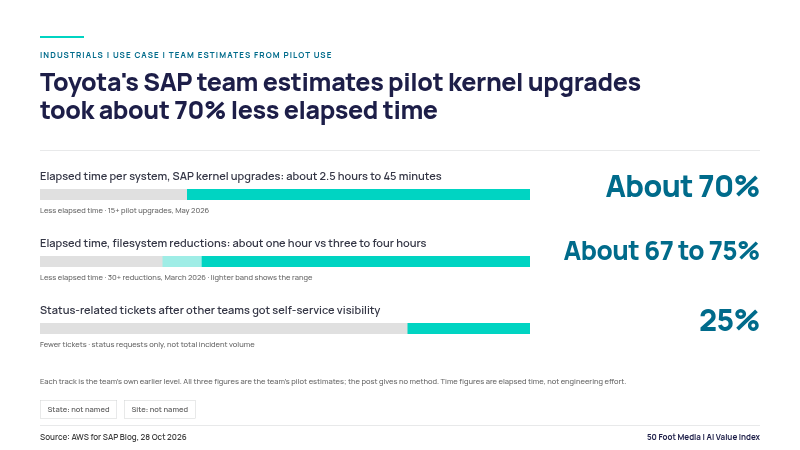
About 2.5 hours to 45 minutes Estimated elapsed completion time per system for SAP kernel upgrades, about 70% less. 15+ pilot upgrades, May 2026. (AWS for SAP Blog, 28 Oct 2026)
About one hour Estimated elapsed time for filesystem reductions, compared with three to four hours previously, about 67 to 75% less. 30+ reductions, March 2026. (AWS for SAP Blog, 28 Oct 2026)
25% Estimated reduction in status-related tickets after other teams got self-service visibility. Status requests only. (AWS for SAP Blog, 28 Oct 2026)
Published on AWS's blog by two AWS staff, co-authored with Toyota Motor North America's SAP team, and built on the AWS services it describes. Every figure is the team's own estimate from pilot use and has not been independently verified.
SAP maintenance leaves no room for improvising. Application servers drain before central services stop, shared databases must not be stopped while the applications that depend on them are still running, and everything comes back up in a set order. Engineers on Toyota Motor North America's SAP team used to work through that runbook while moving between terminals, SAP GUIs, spreadsheets and AWS consoles.
During the pilot, that job changed. In an AWS blog post published October 28, 2026 and co-authored with the team, Toyota describes BasisPilot, an in-house operations platform with an AI assistant built in. It covers "20 SAP systems on 60+ Amazon EC2 hosts across development, test, stage, and production environments." The key line: "During pilot use, the engineer's role shifted from executing a manual runbook to supervising an approved workflow."
The risk with automation is rarely that the tool is too weak. It is switching it on before anyone has built a way to stop it. Toyota's team built the stop first. Viewer roles stay read-only. "Production actions, multi-tenant database hosts, and destructive operations always create a pending approval instead of executing." Before a kernel upgrade, the assistant shows a pre-check with Proceed and Cancel buttons, and at that point "no change has been made." If startup verification fails, the workflow restores the backed-up kernel. "Generated text never becomes a shell command." In the kernel upgrade, the engineer no longer carries out every step. The engineer decides whether the steps run at all.
That order was deliberate. "I started with the decisions a Basis engineer has to make before touching a system: what evidence do I trust, what has to happen in what order, and what should stop me," says Manish Kumar, a senior SAP product owner on the team.
The results so far are the team's estimates from the pilot. Across 15+ kernel upgrades in May 2026, the work went from about 2.5 hours to 45 minutes of elapsed time per system, "a reduction of about 70%." Across 30+ filesystem reductions in March 2026, elapsed time came to approximately one hour, compared with three to four hours before, about 67 to 75% less. The team also estimates "at least 20% less time spent gathering and analyzing operational information," and reports "an estimated 25% reduction in status-related tickets" after other teams were given self-service visibility.
AIVI chart of the team's pilot estimates from the AWS for SAP Blog, 28 Oct 2026. Each track is the team's own earlier level; time figures are elapsed time, not engineering effort.
The write-up also records the time the automation tripped over itself. In early testing, a stalled stop-tracker's retry fired minutes after a successful AI-assisted upgrade had restarted the system, creating a conflicting stop action. The team added workflow locks per system and freshness windows on retries and approvals. A retry, the post says, "must re-check state before acting."
25% Fewer labor hours spent on production scheduling. Automated Production Scheduling · no baseline or plant given. (Foxconn release, 26 Oct 2026; tool name from NVIDIA case study)
50% Less engineering workload for injection-molding process changeovers. Setpoint optimization · no baseline or plant given. (Foxconn release, 26 Oct 2026; tool name from NVIDIA case study)
>90% Correction rate on surface-mount lines, more than 20 major defect root causes addressed. Correction rate not defined. (Foxconn release, 26 Oct 2026)
2.48x Faster training for 120-billion-parameter models vs previous H100-based systems. Measured by Foxconn · one trillion tokens in 12 days. (Foxconn release; NVIDIA case study)
All figures are reported by Foxconn, in its own release and an NVIDIA case study. Neither gives baselines, plant names, time periods or dollar values for the factory results.
Picture a factory on a Thursday. Someone is rebuilding the production plan for the third time. A part that was due on Monday has not turned up, and the week has to be taken apart and put back together again. Foxconn says AI has cut the labor hours it spends on production scheduling by 25%; the figure is its own, from a release dated 26 October, and comes with no baseline, no plant name and no time period.
Put plainly, that is fewer hours spent building and rebuilding the plan. The release does not say how many hours there were to begin with.
AIVI chart of figures from Foxconn's 26 Oct 2026 release. Foxconn gives no baselines, plant names or time periods; bars show the reported shares only.
The release, Foxconn Industrializes Intelligence and Scales the Future With AI Factories, lists two more results from the factory floor. It reports "50% less engineering workload for injection-molding process changeovers." A changeover, in our words, is the work of resetting a molding machine when it moves from one part to the next. And on the surface-mount lines, where components are placed onto circuit boards, it reports "More than 20 major defect root causes addressed, with a correction rate exceeding 90%." It does not say what a correction rate measures.
NVIDIA's case study, which the release links to, names the tools. The 25% belongs to "Automated Production Scheduling (APS)," which it says "reduced labor hours for plant scheduling by 25%." The 50% comes from "setpoint optimization" in injection molding. The release puts the defect results on "surface-mount production lines," plural; the case study says "SMT production line," singular. Neither says how many lines. NVIDIA sells the hardware and software the release says the AI factory runs on.
The rest of the release is about the machinery. FoxBrain, Foxconn's own large language model, is trained on NVIDIA DGX SuperPOD, and Foxconn reports "2.48x faster training for 120-billion-parameter models compared with its previous H100-based systems, processing one trillion tokens in 12 days." The case study footnotes that speedup "As measured by Foxconn." NVIDIA software "helps manage infrastructure and deploy AI agents across more than 200 facilities," the release says; the case study puts it as agents that "can be deployed across 200+ facilities." Neither says how many facilities run them, or which ones the scheduling, changeover or defect results come from.
One trillion tokens in 12 days and 25% fewer scheduling hours sit in the same release, at the same volume, and the reader is left to weigh them.
The value here is hours handed back: to whoever builds the plan, and to the engineer who resets the molding machine. That is how both sources put it, as fewer labor hours and less engineering workload. Neither says where those hours went.
What would let the Index grade this: the hours before and after, the plants where the scheduling and changeover results were measured, the period they cover, what the correction rate counts, and someone outside Foxconn and NVIDIA checking any of it.
A working life is mostly Tuesdays, and a fair few Thursdays spent putting Tuesday's plan back together. If Foxconn's figure holds, somewhere a scheduler is spending less of this week on the plan, and has a few of those hours back. Foxconn has not said where.
 Signal