IndustrialsUse CaseData story
Foxconn says AI cut its production-scheduling labor hours by 25%. It doesn't say where, or compared with what.
Foxconn says AI in its factories cut production-scheduling labor hours by 25% and changeover engineering workload on injection molding by 50%, and addressed more than 20 major defect root causes at a correction rate above 90%. The figures are its own, with no baselines or plant names.

Key figures
- 25% Fewer labor hours spent on production scheduling. Automated Production Scheduling · no baseline or plant given. (Foxconn release, 26 Oct 2026; tool name from NVIDIA case study)
- 50% Less engineering workload for injection-molding process changeovers. Setpoint optimization · no baseline or plant given. (Foxconn release, 26 Oct 2026; tool name from NVIDIA case study)
- >90% Correction rate on surface-mount lines, more than 20 major defect root causes addressed. Correction rate not defined. (Foxconn release, 26 Oct 2026)
- 2.48x Faster training for 120-billion-parameter models vs previous H100-based systems. Measured by Foxconn · one trillion tokens in 12 days. (Foxconn release; NVIDIA case study)
All figures are reported by Foxconn, in its own release and an NVIDIA case study. Neither gives baselines, plant names, time periods or dollar values for the factory results.
Picture a factory on a Thursday. Someone is rebuilding the production plan for the third time. A part that was due on Monday has not turned up, and the week has to be taken apart and put back together again. Foxconn says AI has cut the labor hours it spends on production scheduling by 25%; the figure is its own, from a release dated 26 October, and comes with no baseline, no plant name and no time period.
Put plainly, that is fewer hours spent building and rebuilding the plan. The release does not say how many hours there were to begin with.
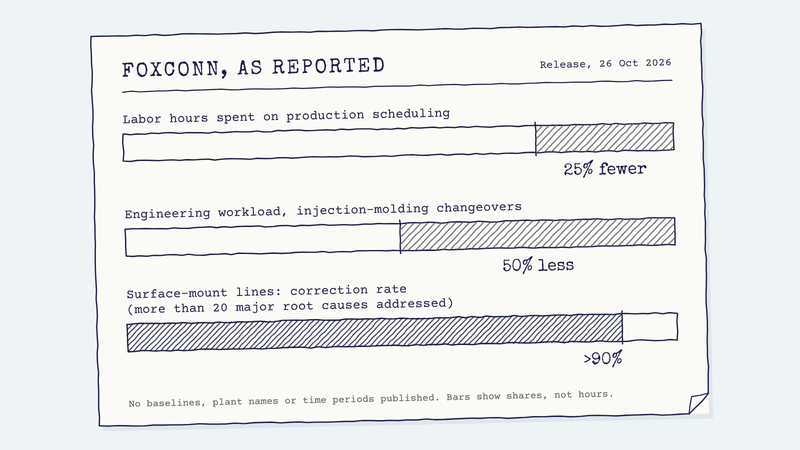
The release, Foxconn Industrializes Intelligence and Scales the Future With AI Factories, lists two more results from the factory floor. It reports "50% less engineering workload for injection-molding process changeovers." A changeover, in our words, is the work of resetting a molding machine when it moves from one part to the next. And on the surface-mount lines, where components are placed onto circuit boards, it reports "More than 20 major defect root causes addressed, with a correction rate exceeding 90%." It does not say what a correction rate measures.
NVIDIA's case study, which the release links to, names the tools. The 25% belongs to "Automated Production Scheduling (APS)," which it says "reduced labor hours for plant scheduling by 25%." The 50% comes from "setpoint optimization" in injection molding. The release puts the defect results on "surface-mount production lines," plural; the case study says "SMT production line," singular. Neither says how many lines. NVIDIA sells the hardware and software the release says the AI factory runs on.
The rest of the release is about the machinery. FoxBrain, Foxconn's own large language model, is trained on NVIDIA DGX SuperPOD, and Foxconn reports "2.48x faster training for 120-billion-parameter models compared with its previous H100-based systems, processing one trillion tokens in 12 days." The case study footnotes that speedup "As measured by Foxconn." NVIDIA software "helps manage infrastructure and deploy AI agents across more than 200 facilities," the release says; the case study puts it as agents that "can be deployed across 200+ facilities." Neither says how many facilities run them, or which ones the scheduling, changeover or defect results come from.
One trillion tokens in 12 days and 25% fewer scheduling hours sit in the same release, at the same volume, and the reader is left to weigh them.
The value here is hours handed back: to whoever builds the plan, and to the engineer who resets the molding machine. That is how both sources put it, as fewer labor hours and less engineering workload. Neither says where those hours went.
What would let the Index grade this: the hours before and after, the plants where the scheduling and changeover results were measured, the period they cover, what the correction rate counts, and someone outside Foxconn and NVIDIA checking any of it.
A working life is mostly Tuesdays, and a fair few Thursdays spent putting Tuesday's plan back together. If Foxconn's figure holds, somewhere a scheduler is spending less of this week on the plan, and has a few of those hours back. Foxconn has not said where.
Get new AI Value Index records in your inbox.
Subscribe